
Sourcing Guide · Lighting
LED & Industrial Lighting: A Sourcing Guide for Malaysia
Lighting is measured in the wrong unit by most buyers — watts describe energy drawn, not light delivered. This guide reframes the purchase around lumens and efficacy, separates retrofit from new fit-out, and covers the high-bay, downlight and emergency-lighting decisions that shape an industrial lighting order.
 Sourcing guide
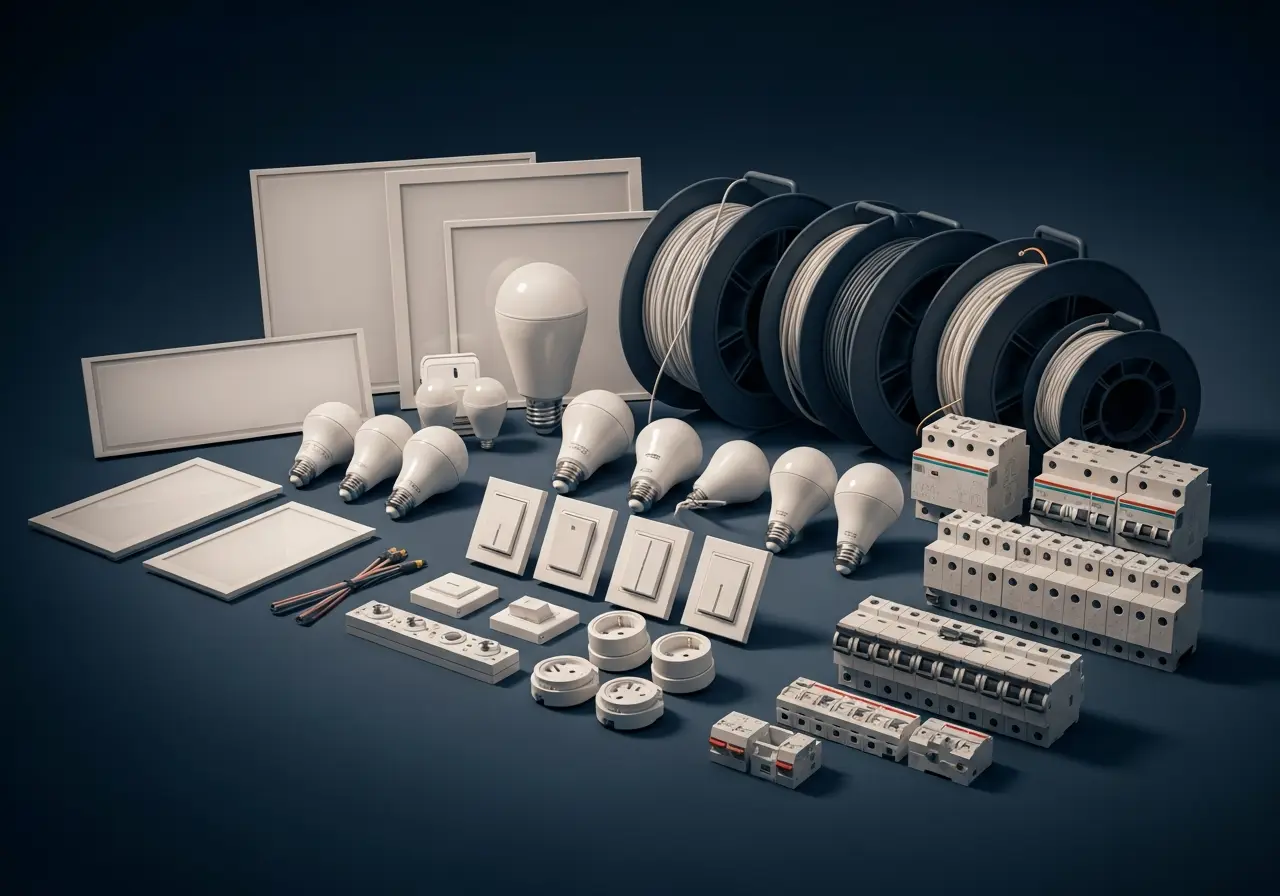
Sourcing LED and industrial lighting means specifying light output (lumens) and efficacy (lumens per watt) rather than wattage, then matching the fitting to the space: high-bay luminaires for tall warehouse and factory ceilings, downlights and panels for offices, floodlights for yards and facades, and dedicated emergency and exit lighting for compliance. Decide early between a retrofit — swapping lamps or fittings into existing points — and a new fit-out that re-plans the layout. Estimate payback from the energy and maintenance saved against the fitting cost. Consolidating the purchase through a managed marketplace such as Lapasar gives buyers access to 10,000+ suppliers on one account, with credit terms for approved businesses and delivery across Peninsular Malaysia.
Key takeaways
- Specify lumens (light delivered) and efficacy in lumens per watt — not wattage, which only describes energy drawn.
- Match the fitting to ceiling height and use: high-bay for tall industrial spaces, downlights and panels for offices, floodlights for outdoor areas.
- Retrofit swaps into existing points and wiring; a new fit-out re-plans the layout — the two have very different cost and downtime profiles.
- Emergency and exit lighting is a compliance item, not an optional extra, and is specified separately from general lighting.
- Payback comes from lower energy draw plus fewer lamp replacements — model both against the fitting cost before committing.
What counts as led & industrial lighting
LED luminaires for commercial and industrial spaces — high-bay fittings, downlights, floodlights, bulbs and emergency lighting — specified by lumen output, efficacy and installation context.
Who typically sources this category
- Manufacturing
- Warehousing & logistics
- Facilities management
- Retail & commercial property
- Construction
Part of the wider Commercial & Industrial Lighting sourcing guide.
Reading a lighting spec: lumens, efficacy, colour and beam
The four numbers that decide a lighting purchase are lumens, efficacy, colour temperature and beam angle. Lumens measure the total light a fitting delivers; efficacy — lumens per watt — measures how much light you get for the energy drawn, and it is the figure that separates a genuinely efficient LED from a cheap one. Colour temperature, in kelvin, sets the appearance: warmer tones for hospitality and reception areas, neutral to cool white for offices, and cool white for factories and warehouses where visual clarity matters. Beam angle determines whether light is thrown wide for area coverage or focused for task and accent work.
Buyers who still specify in watts risk ordering under-lit or over-lit spaces, because LED wattage no longer maps to output the way incandescent wattage once did. Ask for the lumen figure and the efficacy on every line, and check the colour rendering index (CRI) where accurate colour perception matters, such as inspection or retail display.
- Lumens: total light output — the primary sizing number
- Efficacy (lm/W): light delivered per watt drawn — the efficiency measure
- Colour temperature (K): warm, neutral or cool white to suit the space
- Beam angle and CRI: coverage pattern and colour accuracy for the task
High-bay, downlight or floodlight — matching fitting to space
Fitting type follows the space. High-bay luminaires are built for tall ceilings — warehouses, factories, sports halls — where they concentrate high lumen output downward from six metres or more. Low-bay and panel fittings suit standard office and retail ceilings. Downlights recess into ceilings for even ambient light, while floodlights throw broad coverage across yards, loading bays and building facades. Getting this wrong is expensive: a downlight range installed in a high warehouse leaves the floor dim regardless of how many fittings go up.
For industrial spaces, also weigh the ingress protection (IP) rating against the environment — dust and washdown areas need sealed fittings — and the mounting method against the existing structure, since suspended, surface and trunking-mounted high-bays each assume different ceiling support.
See live stock & pricing for led & industrial lighting on mall.lapasar.com
Retrofit versus new fit-out
A retrofit reuses existing lighting points and wiring, swapping old lamps or complete fittings for LED equivalents. It is faster, cheaper and causes less disruption, which makes it the default for occupied offices and running facilities — but it inherits the old layout, so a poorly planned original scheme stays poorly planned.
A new fit-out re-plans the lighting layout from the space up: fitting positions, circuits and controls are all reconsidered. It costs more and takes longer, but it is the right route for a new building, a major refurbishment or a space whose use has changed. Decide which route applies before requesting quotes, because a retrofit quote and a fit-out quote are not comparable.
Emergency lighting and compliance
Emergency and exit lighting is a life-safety system, not a lighting upgrade, and it is specified separately from general lighting. It must illuminate escape routes and exit signage when the mains fail, which means self-contained battery fittings or a central battery system, and it carries its own testing and maintenance duties. Treat it as a distinct line item with its own approval, and keep records of the routine function tests premises are expected to run.
Because it is a compliance item, buyers should confirm that emergency fittings meet the relevant Malaysian and international standards their premises are held to, and that replacement units match the existing emergency-lighting design rather than being dropped in ad hoc.
Energy-saving payback and total cost
The case for LED rests on two savings: lower energy draw for the same light, and far fewer replacements because LED service life runs into tens of thousands of hours. Model both. Take the wattage difference between the old and new fittings, apply your running hours and tariff to get the annual energy saving, then add the avoided cost of relamping — labour included, since replacing high-bay lamps at height is a significant job. Set that against the fitting cost to see the payback period.
Cheaper fittings with poor efficacy or thin driver components can erode the saving through early failure, so weigh warranty length and driver quality alongside headline price. A consolidated purchase lets a facilities team standardise on a few proven fittings across sites rather than accumulating a mix that complicates future replacement.
Sourcing across Peninsular Malaysia
Lighting demand tracks the industrial and commercial property base — the Klang Valley, Penang, Johor Bahru and the manufacturing zones of Perak and Negeri Sembilan — where distributor stock of common fittings is deepest. Specialist high-bay and emergency-lighting lines are more often indent items even in those corridors.
Buying through a consolidated marketplace draws on 10,000+ suppliers with fulfilment through Lapasar's own warehouses and delivery fleet across Peninsular Malaysia, and orders from RM1,000 qualify for free delivery in the Klang Valley, Penang, Johor, Perak and Negeri Sembilan. For live stock and pricing on specific fittings, the industrial lighting catalogue on mall.lapasar.com carries the current range.
Explore the range on mall.lapasar.com
The transactional catalogue — live stock, business pricing and volume quotations — lives on mall.lapasar.com. Start from these led & industrial lighting ranges:
Keep planning with these guides
Common questions
- Why should we specify lumens instead of watts?
- Watts describe the energy a fitting draws, not the light it delivers. With LED, a low-wattage fitting can out-light a higher-wattage one, so ordering by wattage risks an under- or over-lit space. Specify the lumen output for the light you need, and check efficacy — lumens per watt — to compare how efficiently different fittings deliver it.
- When is a retrofit better than a full fit-out?
- A retrofit reuses existing points and wiring, so it is faster, cheaper and less disruptive — the right choice for an occupied office or a running facility with a reasonable existing layout. A new fit-out re-plans the whole scheme and suits new buildings, major refurbishments or spaces whose use has changed. Decide which applies before requesting quotes, because the two are not directly comparable.
- What fitting suits a warehouse with high ceilings?
- High-bay luminaires are designed for ceilings above roughly six metres, concentrating high lumen output downward to light the floor. Check the ingress protection rating for dusty or washdown areas and confirm the mounting method suits your ceiling structure. Standard downlights or panels are not suitable for tall industrial spaces.
- Is emergency lighting part of a general lighting order?
- It should be treated separately. Emergency and exit lighting is a life-safety system that must work when the mains fail, with its own standards, testing duties and maintenance records. Specify it as a distinct line item and make sure replacement units match the existing emergency-lighting design.
- How do we estimate the payback on LED lighting?
- Take the wattage difference between old and new fittings, apply your running hours and electricity tariff to find the annual energy saving, then add the avoided relamping cost including the labour of replacing lamps at height. Compare that combined saving against the fitting cost to get the payback period, and weigh warranty and driver quality so early failures do not erode it.
Didn't find your answer?
Ask us directly — WhatsApp or email, whichever suits you.
Explore related across the knowledge graph
Ready to act on this guide?
The led & industrial lighting catalogue on mall.lapasar.com carries live stock and business pricing from 10,000+ suppliers — with credit terms for approved buyers and delivery across Peninsular Malaysia.
Prefer to talk to a real person?
Our team replies fast on WhatsApp and email — no forms, no waiting.