
Agentic AI in Procurement: Practical Use Cases Teams Can Adopt in 2026
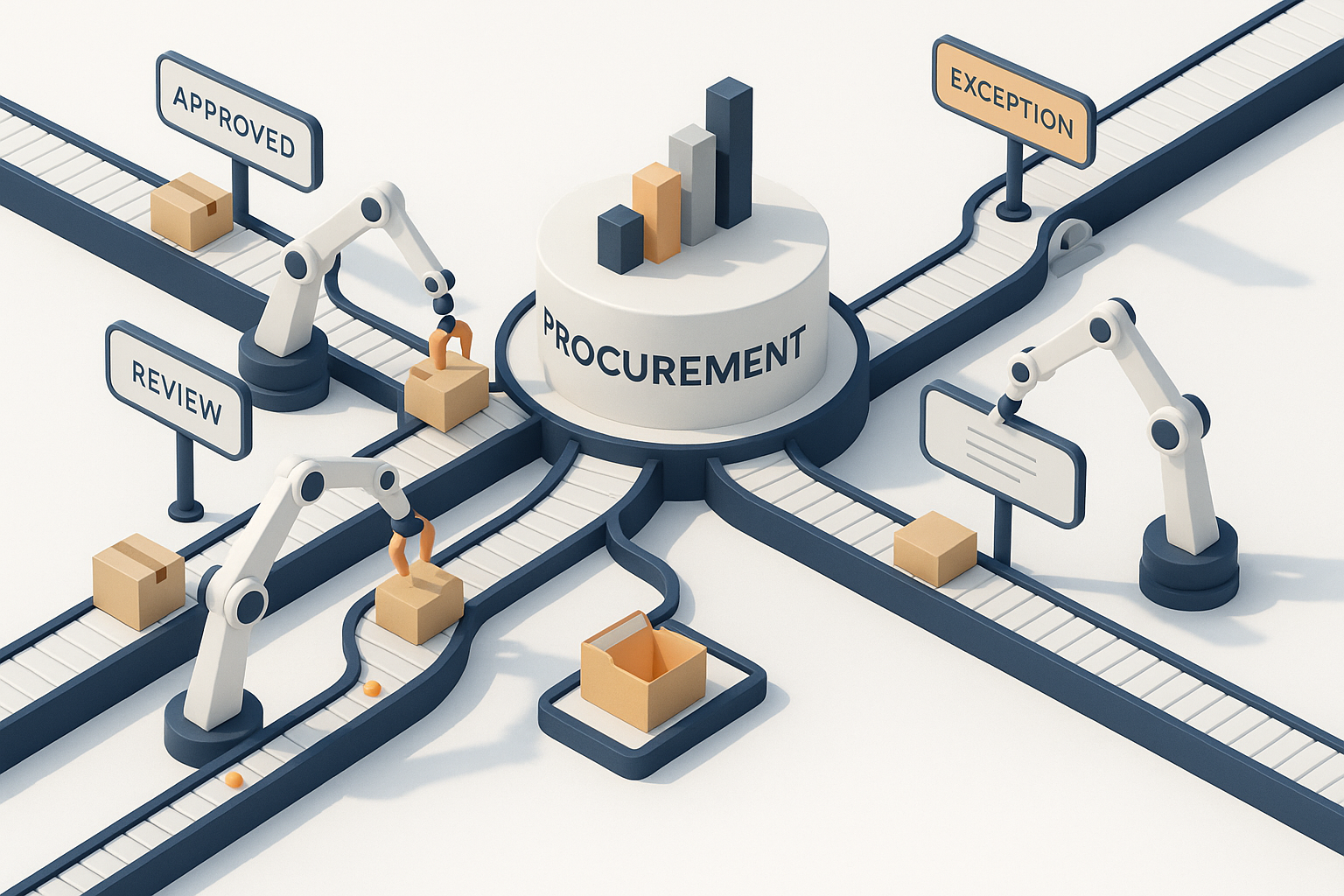
Procurement teams have spent years automating forms, approvals and reports. Agentic AI is the next step: tools that do not just answer questions, but can carry out multi-step procurement tasks under defined rules, with human review where needed. For Malaysian businesses planning for 2026, the real opportunity is not replacing buyers, but removing repetitive coordination work so teams can focus on sourcing strategy, supplier management and control.
Quick answer
Agentic AI in procurement means using AI systems that can understand a goal, break it into steps, take approved actions across tools and escalate exceptions to humans. In 2026, the most practical use cases are guided intake, supplier discovery, quote comparison, contract obligation tracking, invoice exception handling and reorder orchestration. The best results usually come when teams start with narrow, rules-based workflows and set clear approval, audit and compliance guardrails.
What agentic AI means in procurement
Most procurement teams are already familiar with basic AI features such as chat search, document summaries or invoice data extraction. Agentic AI goes further.
Instead of only generating an answer, an agentic system can:
- receive a procurement objective
- decide which steps are required
- gather information from multiple systems
- propose or perform actions within approved limits
- ask for human approval when a threshold or exception is triggered
- log what it did for audit review
In practice, that means a procurement agent might:
- collect missing purchase request details from a requester
- match the request to approved catalogues or contracts
- identify suitable suppliers
- prepare an RFQ pack
- compare supplier responses against required criteria
- draft a recommendation for review
- route the file to the right approver
That is very different from a simple chatbot that just explains policy.
Why agentic AI matters in 2026
By 2026, many procurement teams will not be asking whether AI can help. They will be asking which workflows deserve agent-style autonomy and which must remain fully human-led.
The pressure is practical:
- lean teams handling more categories and more stakeholders
- rising expectations for faster turnaround
- growing compliance requirements around approvals, tax records and documentation
- fragmented supplier and spend data across email, ERP, procurement tools and finance systems
- more demand for procurement to provide insights, not just process transactions
Agentic AI is attractive because procurement work is full of repeatable decision paths. A large share of daily activity involves chasing information, validating requests, comparing options, spotting mismatches and moving work to the next step. These are good candidates for agent support when policies are clear.
Where agentic AI is most useful in procurement
The strongest use cases usually share four traits:
- The workflow is frequent.
- The rules are reasonably well defined.
- The cost of delay is meaningful.
- A human can review exceptions before risk increases.
The table below shows where agentic AI tends to fit best.
Procurement activityGood fit for agentic AI?Why it worksHuman rolePurchase intake and triageHighRepetitive, rules-based, many missing fieldsApprove unusual requestsGuided buying and catalogue routingHighClear policies, preferred items, budget rulesHandle exceptions and substitutionsSupplier discovery and pre-screeningMedium to highGood for initial filtering and document collectionFinal qualification decisionRFQ preparation and quote comparisonHighMulti-step coordination and structured comparisonsNegotiate and awardContract review for obligationsMediumUseful for extracting clauses and remindersLegal and procurement approve interpretationInvoice exception handlingMedium to highGood for matching issues and workflow routingApprove disputed casesStrategic sourcing and complex negotiationMediumAI can support research and scenario analysisHumans lead strategy and relationship managementSupplier relationship managementMediumAI can monitor performance and flag issuesHumans manage trust, improvement and disputesPractical use cases teams can adopt in 2026
Intake agents that clean up poor purchase requests
Many procurement delays start before sourcing begins. Requesters submit incomplete descriptions, unclear specifications or missing cost centre details. An agentic intake workflow can ask follow-up questions automatically, suggest the right category and check whether the need already exists in a contracted catalogue.
A practical intake agent can:
- convert free-text requests into structured fields
- prompt for delivery location, quantity, required date and business justification
- identify whether the item is likely MRO, office supplies, IT, marketing or facilities related
- route requests to the correct buying channel
- flag possible policy issues, such as off-contract buying or split purchases
For Malaysian companies, this matters because a cleaner request record makes downstream approval, SST treatment, invoice matching and LHDN documentation easier to manage.
Guided buying agents that steer users to compliant options
A common source of unmanaged spend is not bad intent but user convenience. Employees often buy outside preferred channels because finding the right item takes too long.
An agentic guided buying flow can:
- interpret what the user actually needs
- map it to approved SKUs or supplier categories
- present alternatives based on policy, budget or lead time
- escalate only when there is no compliant option
This is especially useful for recurring indirect procurement, where speed matters but controls still matter. The goal is not to overwhelm users with search results, but to reduce decision effort while keeping purchases within approved pathways.
Supplier discovery and pre-screening agents
Finding potential suppliers is rarely the hardest part. Shortlisting viable suppliers is. Procurement teams often need to verify business registration, category fit, delivery capability, commercial terms and required documents.
An agentic workflow can support the early stage by:
- compiling candidate suppliers from internal records and approved external sources
- checking whether required documents have been submitted
- classifying suppliers by category and region
- identifying obvious gaps for follow-up
- preparing a pre-screening summary for the buyer
The important limit: supplier qualification should not be handed fully to an AI agent. Procurement must still make final decisions, especially where operational criticality, safety, service quality or regulatory compliance are involved.
Where relevant, teams may also include checks tied to MOF registration requirements for public sector-related needs or internal vendor onboarding standards for finance and compliance.
RFQ orchestration agents
This is one of the clearest near-term use cases. RFQs involve repetitive but time-consuming coordination: gathering specifications, selecting suppliers, sending requests, tracking responses and normalising quote data for comparison.
An agentic RFQ assistant can:
- generate an RFQ pack from the approved request
- suggest suppliers based on category, geography and past performance
- send reminders before quote deadlines
- standardise quote formats into a comparison sheet
- highlight deviations such as minimum order quantity, lead time or payment term differences
- draft a recommendation memo for procurement review
This does not replace negotiation. It reduces admin load so buyers can spend more time evaluating total value and supplier risk.
Quote analysis agents for apples-to-apples comparisons
One of the most frustrating procurement tasks is comparing supplier quotes that arrive in different formats, units or commercial assumptions. An agent can help turn messy quote sets into a decision-ready view.
Useful capabilities include:
- unit of measure normalisation
- line-item matching across supplier submissions
- identification of hidden charges or exclusions
- alerts on unusual pricing variances compared with internal history
- scenario comparison for delivery, warranty or credit terms
Teams should still be cautious. If specifications are inconsistent, the AI may produce a neat comparison on top of bad inputs. Human validation remains essential before award.
Contract obligation and renewal agents
Many procurement problems come from contracts not being actively managed after signing. Important clauses sit in PDFs until a renewal date is missed, a price review window closes or service credits are not claimed.
An agentic contract workflow can:
- extract key obligations, notice periods and renewal terms
- assign reminders to category owners
- monitor for pricing review dates or volume commitments
- compare actual buying behaviour against contracted terms
- flag where a contract exists but spend is leaking elsewhere
This is a useful example of agentic AI not making decisions on its own, but continuously monitoring and nudging action where people would otherwise miss timing.
Invoice exception handling agents
Finance and procurement often spend too much time resolving mismatches that are routine but tedious. Examples include quantity mismatches, missing PO references, duplicate invoices or price differences.
An agentic exception workflow can:
- classify the type of invoice mismatch
- pull the related PO, goods receipt and supplier record
- suggest the likely resolution path
- route the case to the right owner
- draft a supplier query where supporting information is missing
- maintain an audit log of actions taken
This can improve speed without weakening control, provided approval thresholds stay with authorised employees and all actions remain traceable.
Reorder and stock support agents for recurring procurement
For teams managing repeated purchases of operational supplies, an agent can monitor consumption signals and trigger a reorder workflow before stock becomes a problem.
Examples include:
- pantry and office consumables
- cleaning supplies
- packaging materials
- maintenance items
- branch replenishment items
A practical agent does not simply auto-buy. It can:
- detect likely replenishment needs
- check open orders and usage trends
- suggest reorder quantities
- route a draft cart or PR for approval
- avoid duplicate purchases across sites
This is where agentic AI can reduce urgent spot buying, which often leads to higher cost and weaker compliance.
What agentic AI should not do without guardrails
Procurement leaders should be careful not to frame agentic AI as “hands-free purchasing”. That is the wrong operating model for most businesses.
High-risk actions should stay under explicit human control, including:
- supplier appointment or disqualification
- contract award decisions for significant spend
- negotiation of final commercial terms
- changes to payment instructions or bank details
- policy overrides
- approval of non-standard tax, legal or compliance treatment
In other words, agentic AI should handle process work and prepare recommendations. Humans should remain accountable for judgement-heavy decisions.
Key risks Malaysian teams should plan for
Poor master data and inconsistent policies
An agent is only as reliable as the rules and records it can access. If supplier names, item masters, approval matrices and contract records are inconsistent, the agent may make the workflow faster but not better.
Before rollout, review:
- supplier master cleanliness
- item and category taxonomy
- approval rules
- payment term standards
- contract metadata
- receiving and invoicing workflows
Weak auditability
Procurement and finance need to know what the system did, why it did it and what data it used. This matters for internal control, external audit and issue resolution.
At minimum, teams should require:
- action logs
- source references
- approval records
- exception history
- role-based permissions
Over-automation of supplier-facing communication
Suppliers may appreciate faster responses, but they will not appreciate confusing or contradictory automated messages. Agentic communication should be templated, reviewable and limited to appropriate use cases.
Data security and confidentiality
Procurement data often includes pricing, contracts, bank details, forecasts and commercially sensitive requirements. Teams need clear rules on what data can be exposed to AI tools, where it is stored and who can access outputs.
Policy drift
If internal procurement policies are outdated, undocumented or interpreted differently across business units, an AI agent may simply institutionalise that confusion. Governance must come before autonomy.
How to adopt agentic AI in procurement without losing control
1. Start with one workflow, not a grand transformation
Choose a process with visible friction and clear rules. Good starting points are intake triage, RFQ orchestration or invoice exception routing.
2. Define the agent’s authority clearly
Document what the agent can do, what it can recommend and what always requires human approval.
A simple authority model might include:
- observe only
- draft only
- act within limits
- escalate exceptions
3. Set policy and approval guardrails first
Do not automate around unclear approval thresholds, vague sourcing rules or undocumented exceptions. Clean up the policy design first.
4. Build for auditability
Every action should be reviewable. If a buyer or auditor cannot reconstruct what happened, the workflow is not procurement-grade.
5. Measure operational outcomes, not novelty
Track whether the agent reduces cycle time, improves first-time-right requests, lowers exception volume or increases contract-channel use. Avoid measuring success only by how advanced the technology sounds.
6. Keep humans in exception handling and supplier judgement
The most successful setups combine automation for routine paths with human ownership of ambiguity, negotiation and relationships.
A practical 2026 roadmap for procurement teams
A sensible roadmap for many organisations looks like this:
Phase 1: Assist
Use AI to summarise requests, classify spend, extract contract clauses and prepare comparison drafts.
Phase 2: Orchestrate
Let agents move work between systems, chase missing information and route standard cases based on rules.
Phase 3: Act within limits
Allow agents to send standard RFQs, trigger reminders, create draft orders or route invoice exceptions automatically.
Phase 4: Optimise continuously
Use agent outputs to improve policies, supplier coverage, catalogue quality and approval design.
This staged approach is usually safer than trying to automate end-to-end procurement all at once.
The real value: less admin, better control, faster decisions
The strongest business case for agentic AI in procurement is not futuristic autonomy. It is practical execution. Teams can reduce repetitive coordination, improve compliance and surface better information at the moment decisions are made.
For Malaysian organisations, the winning approach in 2026 will likely be selective adoption:
- automate routine paths
- preserve strong approvals
- maintain clean audit trails
- protect supplier relationships
- align outputs with finance, tax and internal control requirements
That balance matters more than chasing the most advanced feature set.
Final takeaway
Agentic AI is most useful when procurement treats it as a controlled workflow operator, not a replacement for commercial judgement. Start where the work is repetitive, rules are clear and auditability is possible. Then expand gradually.
For teams that also want simpler access to approved suppliers and recurring business purchasing, platforms such as Lapasar can complement this journey with a large supplier and SKU base, MOF registration, credit terms and operational fulfilment support across Peninsular Malaysia. But the foundation still comes first: good process design, clean data and clear human accountability.