
Automation vs Manual Procurement: An Honest Comparison
Every procurement leader has sat through the vendor pitch: automation will cut costs 40%, eliminate errors, and free your team for "strategic work." Every procurement leader has also inherited at least one system that was supposed to do exactly that and instead became an expensive way to generate PDFs.
So let's do the comparison honestly — not automation versus a strawman, but automation versus what manual procurement actually does well, and where each one genuinely breaks.
The comparison that matters
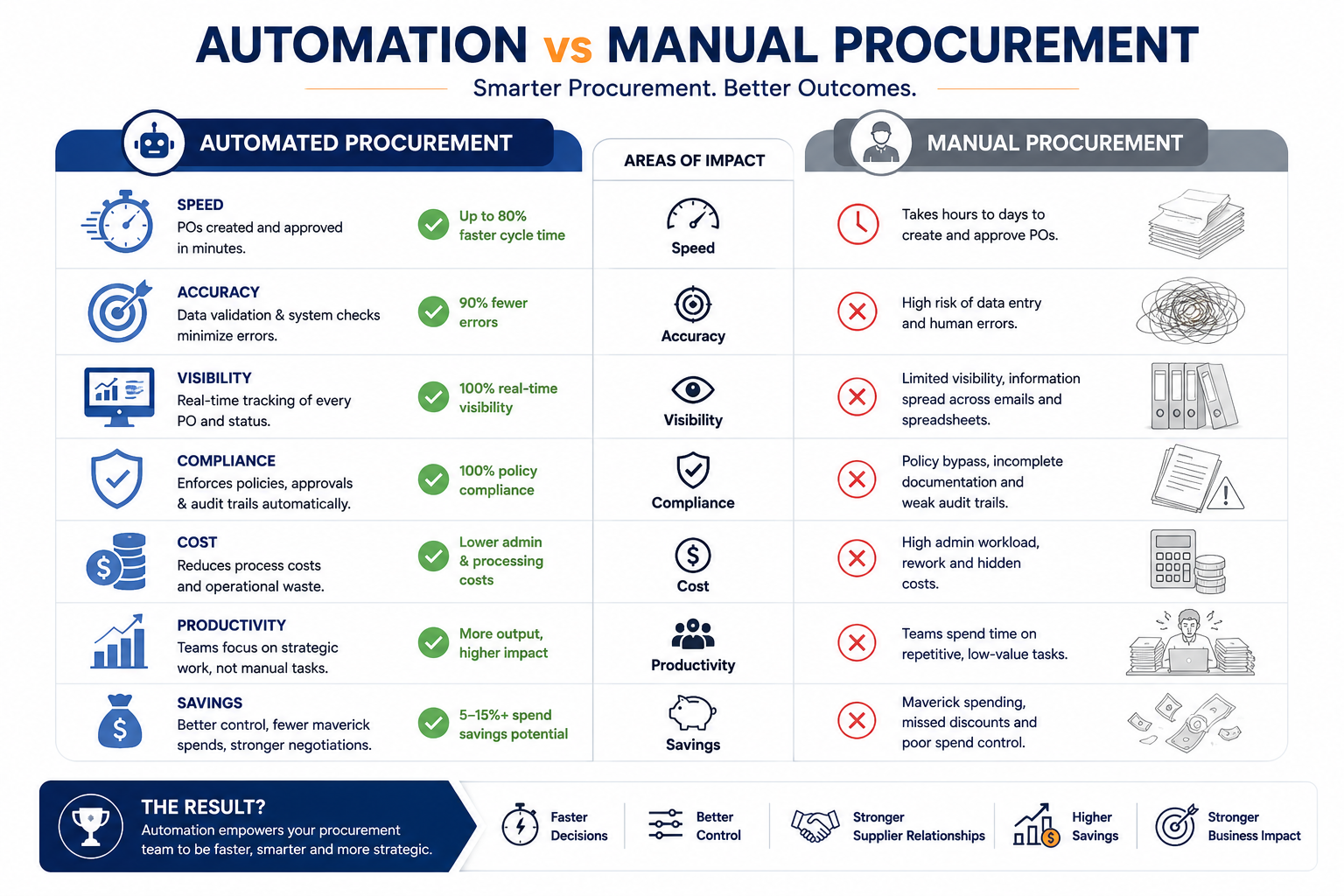
Speed. Manual procurement moves at the speed of inboxes. A requisition-to-PO cycle of 3–7 days is normal; 14 days is not rare in approval-heavy GLC environments. Automated flows compress catalogue purchases to under 24 hours because the delay was never the decision — it was the queue in front of the decision. Winner: automation, and it isn't close.
Cost per transaction. Industry benchmarks from APQC and Ardent Partners consistently place manual PO processing at USD 50–150 fully loaded, versus single digits for touchless orders. At 500 POs a month, the gap alone funds the software several times over. Winner: automation — at volume. Below a few hundred orders a month, the maths gets thinner and implementation cost dominates.
Error rates. Every manual handoff — retyping a requisition, keying an invoice, matching a delivery order by eye — carries a defect rate. Those defects surface as duplicate payments, wrong-item deliveries, and month-end reconciliation marathons. Automation doesn't eliminate errors; it eliminates transcription, which is where most of them live. Winner: automation.
Judgment calls. Complex negotiations, single-source justifications, new supplier evaluation, anything strategic or ambiguous — manual, human procurement is not just acceptable here, it's the point. No workflow engine should be negotiating your three-year logistics contract. Winner: manual — permanently.
Exceptions and edge cases. Urgent one-off buys, non-catalogue items, disaster response purchasing. Rigid automation handles these badly, and badly designed systems force staff back into the shadow processes automation was meant to kill. Good systems have a fast manual lane with digital documentation. Winner: manual execution, automated recording.
Visibility and control. This is the least discussed and most valuable difference. Manual procurement produces information after the fact — you learn what was bought when the invoice arrives. Automated procurement produces information before commitment: budget checks at requisition, contract compliance at selection, spend analytics in real time. You cannot manage maverick spend you cannot see, and manual processes structurally cannot show it to you. Winner: automation, decisively.
Audit and compliance. Manual approval trails live in email threads, WhatsApp forwards, and someone's desktop folder. For enterprises answering to internal audit, board procurement committees, and MACC-adequate-procedures frameworks, reconstructing those trails is slow and fragile. Automated systems produce the trail as a by-product of the work. And with LHDN's e-Invoicing mandate now covering effectively all Malaysian businesses, the invoice side of every transaction is already structured digital data — matching it manually against spreadsheet POs is running half a digital process at full manual cost. Winner: automation.
Flexibility during change. Reorganisations, new subsidiaries, emergency suppliers, policy pivots — manual processes adapt the same afternoon; badly built automation waits for a change request. This is a real cost, and the answer is choosing systems where business users can edit approval matrices and catalogues without a developer. Winner: manual, unless the system is configurable — then neutral.
The scorecard, honestly read
Automation wins on speed, cost at volume, error elimination, visibility, and auditability — which happen to be the five things that determine procurement's cost and control footprint. Manual wins on judgment, edge cases, and adaptability — which happen to be the things procurement professionals should be spending their time on anyway.
That's the real conclusion: the comparison isn't automation or manual. It's automation for the transactional 80% so your people can be manual — deliberately, skilfully manual — on the strategic 20%. Enterprises that frame it as headcount replacement automate the wrong things and then wonder why compliance collapsed. Enterprises that frame it as reallocating human attention get both the cost curve and the capability upgrade.
Where manual procurement is actively dangerous
Three situations where staying manual is no longer a neutral choice:
High order volume with low average value. Consumables, MRO, branch-level purchasing. The processing cost can exceed the item cost, and no amount of diligence fixes that ratio manually.
Multi-entity or multi-branch approval. Once approvals cross entities, manual routing decays into bottlenecks and rubber-stamping — usually both at once, in different departments.
Post-e-Invoicing compliance. Structured invoices matched by hand against unstructured orders is a growing exception pile with a regulatory clock on it.
How to sequence the transition
Don't automate everything; automate in this order:
Catalogue purchases first — highest volume, clearest rules, fastest payback, and it builds the internal credibility everything else needs.
Approval workflows second — but write the approval matrix down before buying anything. Most automation delays are governance gaps wearing a software costume.
Three-way matching third — once PO and receiving data are clean, matching against LHDN-validated e-invoices is where the finance team's month-end pain actually dies.
Strategic sourcing last, or never — tools can support it; they cannot do it. Budget accordingly.
The bottom line
Manual procurement isn't wrong — it's just wrong for transactions. It was designed for a volume of purchasing that Malaysian enterprises outgrew a decade ago, and the e-Invoicing era has quietly removed its last excuse. Keep humans where judgment lives. Take them out of everywhere they've been reduced to retyping.
The companies getting this right aren't the ones with the biggest automation budgets. They're the ones who could tell you, precisely, which 80% of their orders no human should ever touch again.
Lapasar Research — Procurement Research & Insights. Lapasar's Enterprise Procurement platform connects Malaysian enterprises and GLCs to over 2 million SKUs with automated requisition-to-PO workflows.