
Digital procurement in education: how schools and universities modernise purchasing
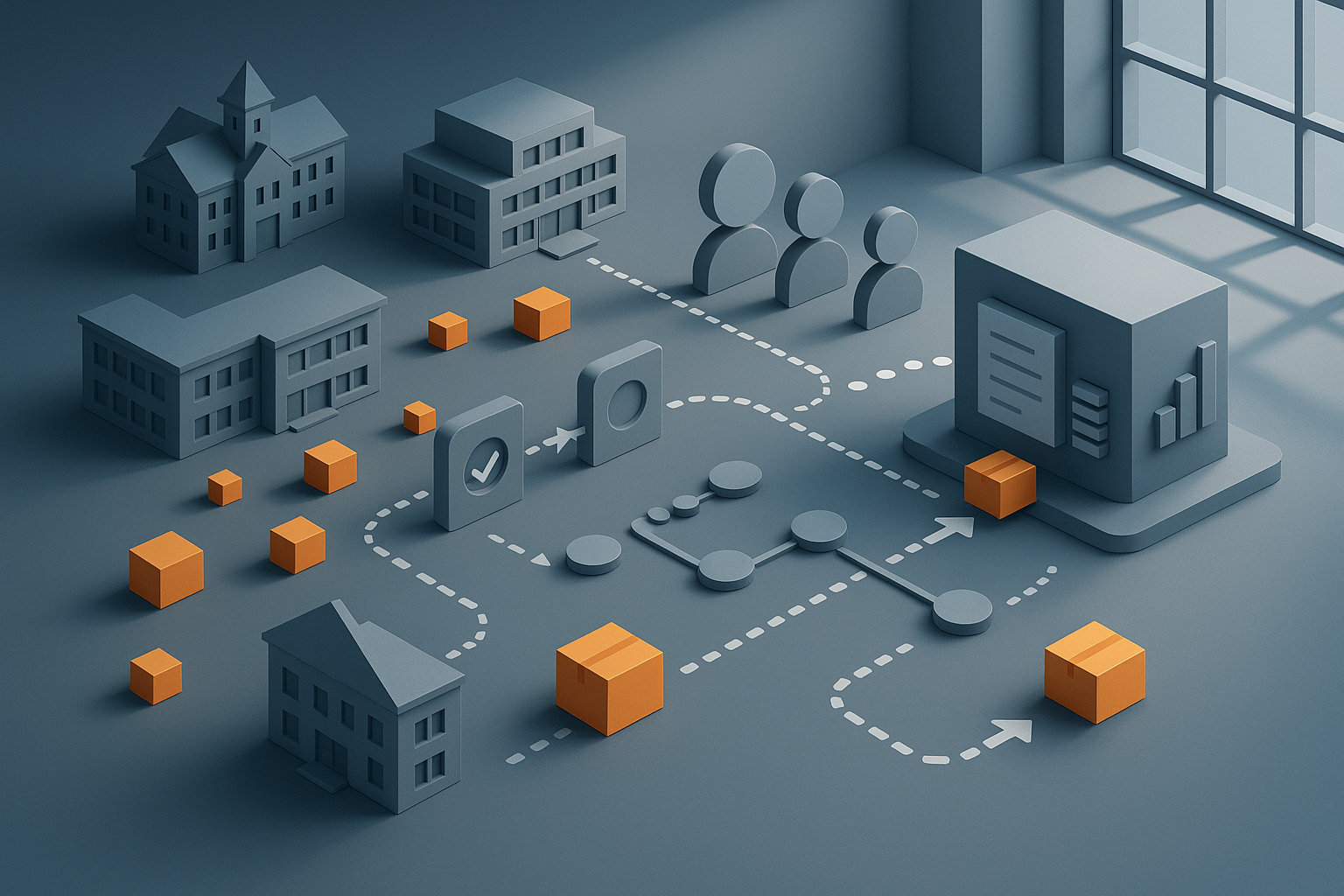
Education institutions buy far more than stationery and paper. A typical school, college or university may need IT equipment, lab supplies, facilities maintenance items, pantry goods, event materials, furniture and outsourced services, often across multiple departments and campuses. When these purchases are handled through emails, paper forms, chat messages and scattered spreadsheets, delays and visibility gaps become hard to avoid.
Quick answer
Digital procurement in education means moving purchasing activities from manual, fragmented processes into a controlled digital workflow. For schools and universities, this usually includes supplier management, request and approval flows, catalogue-based buying, budget tracking, purchase orders and invoice matching in one system or connected process. The result is usually better control, faster processing and clearer audit records for finance, operations and academic departments.
Why education institutions are modernising procurement
Education procurement is rarely simple. Even smaller institutions often serve multiple user groups with different needs:
- administrators buying office and facilities supplies
- lecturers and faculty teams requesting teaching materials
- laboratories needing specialised items
- hostels and food service teams replenishing consumables
- maintenance teams sourcing repair items
- student affairs teams arranging events and campus activities
In many institutions, each function develops its own buying habits over time. One department may email requests to finance, another may call suppliers directly, while another may keep its own spreadsheet tracker. This creates a few common problems.
Limited visibility over total spend
When purchases happen through disconnected channels, finance teams struggle to answer basic questions:
- What has been ordered already?
- Which department is spending the most?
- Are purchases staying within budget?
- Are the same items being bought from different suppliers at different prices?
Without a digital trail, spend analysis becomes a manual exercise at month end rather than an ongoing management tool.
Slow approvals that affect operations
Education environments run on fixed calendars. Semester start dates, examination periods, intake cycles and campus events create time-sensitive demand. If procurement approvals are slow, teams may face:
- delayed classroom or lab setup
- urgent off-contract buying
- last-minute courier charges
- stockouts of operational essentials
- rushed purchasing with weaker controls
Weak standardisation across departments or campuses
Large institutions often buy similar products repeatedly across faculties, branches or campuses. Without digital procurement, standardisation is difficult. Different teams may source similar goods separately, using inconsistent specifications, supplier terms or documentation.
Audit and compliance challenges
Schools and universities must usually maintain strong records for internal governance, budgeting reviews and audits. Manual procurement makes it harder to show:
- who requested an item
- who approved it
- why the supplier was chosen
- whether the purchase matched policy
- whether goods were received before payment
In Malaysia, institutions also need to maintain proper documentation for tax, accounting and governance purposes, including invoices and supporting records relevant to finance review and LHDN recordkeeping obligations.
What digital procurement means in practice
Digital procurement does not always mean replacing everything at once. In education, it often starts by digitising the most repetitive and controllable parts of the purchase cycle.
Core elements of a digital procurement setup
A practical digital procurement model often includes:
- supplier database with approved vendors and category controls
- digital requisitions instead of paper or email requests
- approval workflows based on budget owners, departments or thresholds
- catalogue buying for common items with pre-agreed specifications
- purchase order creation from approved requests
- goods receipt confirmation by the receiving team or requestor
- invoice matching against PO and receipt records
- spend reporting by department, category, supplier or campus
Not every institution will implement all features at once. But even a few of these steps can significantly improve control and speed.
How manual and digital procurement differ
The difference is not just convenience. It changes how institutions manage risk, accountability and cost control.
AreaManual purchasingDigital procurementRequest submissionEmail, paper forms, messaging appsStandardised online requisition workflowApprovalsInformal, hard to trackTime-stamped approval routingSupplier usageVaries by departmentApproved supplier controlsProduct selectionFree-form descriptionsCatalogues and standardised itemsBudget visibilityOften after the factBetter visibility before approvalPO creationRe-keying and manual documentsGenerated from approved requestsAudit trailScattered across files and inboxesCentralised recordsReportingSpreadsheet-heavyFaster, structured analysisThe biggest benefits for schools and universities
Digital procurement can support both administrative efficiency and educational continuity.
Better budget discipline
Education institutions usually work within tightly managed annual budgets. Department heads need to know what has been committed, what remains available and where exceptions are happening.
A digital process helps by:
- routing requests to the right budget owner
- checking spending before a purchase is committed
- reducing duplicate or unnecessary orders
- making committed spend more visible earlier
This matters especially when several departments buy from the same operating budget or when campuses share central procurement oversight.
More consistent purchasing policies
Many institutions want to encourage autonomy for departments while still protecting governance. Digital procurement helps by embedding policy into the workflow.
For example:
- low-risk routine items can be bought from pre-approved catalogues
- higher-value purchases can require additional approval
- restricted categories can be routed through procurement or finance
- preferred suppliers can be prioritised for recurring needs
This reduces policy dependence on memory or manual policing.
Faster turnaround for routine buying
Routine purchases should not consume the same effort as one-off strategic sourcing. With digital procurement, common operational items can move much faster because:
- requestors choose from standard catalogues
- supplier details are already pre-vetted
- approval routes are predefined
- POs can be generated without repeated data entry
That gives procurement and finance teams more time to focus on exceptions, contracts and high-value decisions.
Stronger audit readiness
When records are centralised, institutions are in a much better position during internal review, external audit or management reporting. A complete digital trail can show:
- the original request
- the approver
- the selected supplier
- the issued PO
- receipt confirmation
- the final invoice
That structure is particularly useful in institutions where purchasing responsibility is distributed across many users.
Typical education spend categories that benefit first
Not every category should be digitised in the same way. Schools and universities usually get the quickest wins from repeatable, standardisable purchases.
High-frequency indirect spend
These are often the easiest categories to digitise first:
- office supplies
- printer consumables
- cleaning and janitorial products
- pantry and hospitality items
- maintenance consumables
- classroom basics
- hostel or accommodation supplies
These categories tend to involve repetitive orders, many requestors and frequent approvals.
Controlled academic and departmental spend
Some academic categories are more specialised but still benefit from digital control, such as:
- laboratory consumables
- workshop tools
- art and design materials
- examination materials
- teaching aids
- IT peripherals and accessories
The key is to define where catalogue buying works and where specialist review is still needed.
Service-related procurement with workflow control
Services may be less catalogue-friendly, but digital procurement can still help manage the request and approval stages for:
- maintenance works
- event support
- training services
- equipment servicing
- outsourced campus operations
In these cases, the digital value often comes from approval discipline, supplier records and document retention rather than simple item selection.
A phased approach to modernising education procurement
Trying to digitise every category, supplier and approval rule at once can overwhelm users. A phased rollout is usually more practical.
Phase 1: Standardise the basics
Start with the most common pain points:
- create a central list of approved suppliers
- define basic purchasing categories
- move requisitions into one digital channel
- set simple approval rules by department or value band
- standardise PO issuance
This first phase already reduces informal buying and improves traceability.
Phase 2: Build catalogues for common purchases
Once the workflow is stable, institutions can add structured catalogues for repeat items. This helps users order the right products without writing vague descriptions or requesting quotations for routine goods.
Useful catalogue design principles include:
- grouping by department need
- limiting duplicate item options
- defining standard pack sizes
- clarifying unit of measure
- setting preferred substitutes where appropriate
Phase 3: Improve reporting and budget control
After usage data starts accumulating, finance and procurement teams can analyse:
- spend by campus or faculty
- off-contract purchases
- supplier concentration
- frequently ordered items
- urgent orders versus planned orders
These insights support better sourcing decisions and internal planning.
Phase 4: Connect procurement to finance processes
A more mature setup can connect purchasing with invoice processing, payment workflows and financial reporting. This reduces re-entry, strengthens three-way matching and shortens the gap between ordering and reconciliation.
For Malaysian institutions, this is also where document quality, supplier details and finance records become especially important for internal controls, accounting and tax administration.
How to choose the right digital procurement model
Different institutions need different levels of control. The best setup depends on complexity, user volume and internal capability.
ModelBest forStrengthsWatchoutsBasic digital request and approval workflowSmaller schools or early-stage modernisationQuick visibility and control improvementMay still rely on manual supplier and item managementCatalogue-based procurement platformInstitutions with frequent repeat purchasesFaster ordering, better standardisationNeeds upfront catalogue maintenanceIntegrated procurement and finance workflowLarger institutions with multi-department oversightBetter end-to-end control and reconciliationRequires stronger process design and stakeholder alignmentHybrid model with digital control plus manual exceptionsInstitutions with mixed routine and specialised buyingPractical balance for diverse spend categoriesExceptions can grow if policies are unclearCommon implementation mistakes to avoid
Digital procurement projects often fail not because the idea is wrong, but because the rollout ignores how people actually buy.
Copying corporate workflows without adapting to education
Education institutions have academic calendars, seasonal demand peaks and distributed authority structures. A workflow that works in a corporate head office may be too rigid for a faculty, hostel, lab or campus operations team.
Overcomplicating approvals
Too many approval layers slow down purchasing and encourage workarounds. Keep routine purchases simple, while reserving deeper review for higher-risk or higher-value categories.
Ignoring item and supplier data quality
A system is only as useful as its inputs. If supplier names are inconsistent, items are duplicated or descriptions are unclear, reporting quality suffers quickly.
Skipping user training
Requestors need practical guidance on:
- when to use catalogues
- how to choose the right category
- what documentation is required
- how to handle urgent or exceptional purchases
Without this, digital procurement can become a new layer of confusion instead of a simplification.
Governance points that matter in Malaysia
While each institution has its own policies, Malaysian education organisations should generally keep a close eye on a few operational areas when digitising procurement:
Supplier onboarding and records
Supplier profiles should be maintained with up-to-date business details, banking information where needed, and relevant registration or tax information appropriate to the institution's controls.
Invoice and tax documentation
Finance teams should ensure digital procurement records support proper invoice handling and retention. Where SST is relevant, item categories, invoice details and supplier documentation should be handled consistently.
Approval authority and delegation
Institutions should clearly define who can approve what, especially where department heads, campus administrators and central finance teams share responsibility.
Retention of supporting documents
Quotations, approvals, PO records, delivery confirmations and invoices should be stored in a way that supports audit review and internal governance.
What success looks like after modernisation
A successful digital procurement setup in education does not necessarily mean every purchase is fully automated. It means the institution has a clearer, more reliable purchasing environment.
Signs of progress include:
- fewer purchases initiated through informal channels
- more spend routed through approved suppliers
- faster processing for routine operational items
- cleaner records for audit and finance review
- better visibility over department and campus spending
- less manual chasing for approvals and PO status
Over time, this creates a stronger foundation for strategic sourcing, budgeting and supplier management.
Final takeaway
Digital procurement helps schools and universities modernise purchasing by replacing fragmented manual processes with clearer workflows, stronger approvals and better spend visibility. The most effective approach is usually phased: start with routine categories, standardise approvals, build supplier and catalogue discipline, then strengthen reporting and finance integration.
For Malaysian institutions looking at practical procurement digitisation, it helps to work with partners that understand business purchasing controls, supplier breadth and operational delivery realities. Lapasar, for example, is a MOF-registered procurement platform with 10,000+ suppliers and 2M+ SKUs, and can support recurring business purchasing needs alongside internal process improvement.