
Procurement Trends in 2026
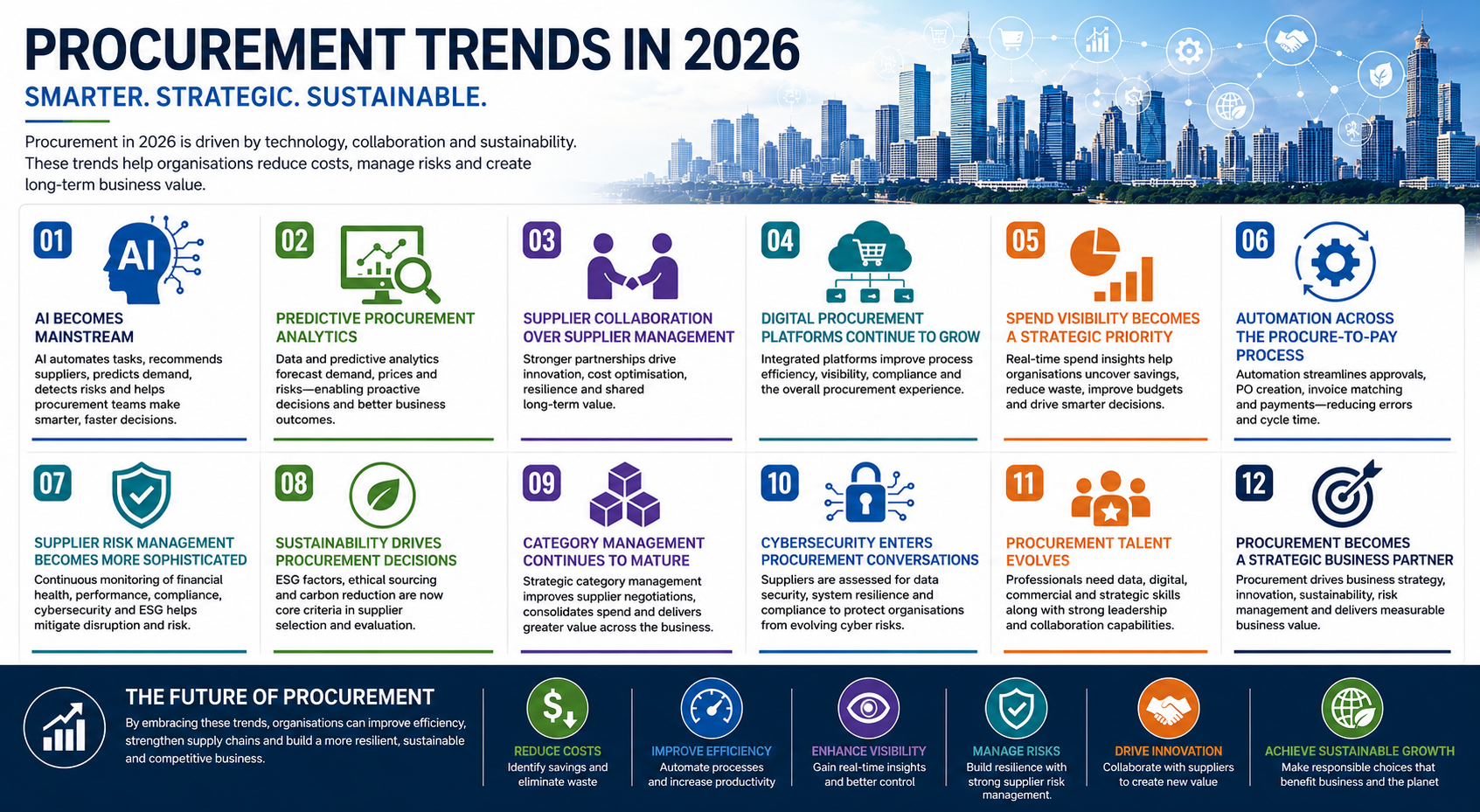
Procurement has evolved far beyond negotiating prices and issuing purchase orders. In 2026, procurement is recognised as a strategic business function that directly influences profitability, operational resilience, sustainability, and long-term business growth.
Rapid technological advancement, economic uncertainty, evolving customer expectations, and increasing regulatory requirements are driving procurement teams to rethink traditional processes. Organisations are investing in smarter technologies and modern procurement practices that enable faster decisions, stronger supplier relationships, and greater control over company spending.
Here are the key procurement trends shaping businesses in 2026.
* Artificial Intelligence Becomes Mainstream
Artificial Intelligence (AI) is no longer an emerging technology—it has become an essential procurement tool.
Modern procurement teams use AI to:
Recommend suppliers Compare quotations automatically Predict purchasing demand Detect unusual spending patterns Generate sourcing recommendations Identify potential procurement risks * Automate repetitive administrative tasks
Instead of replacing procurement professionals, AI enables them to focus on strategic decision-making, supplier negotiations, and value creation.
* Predictive Procurement Analytics
Procurement decisions are increasingly driven by data rather than intuition.
Businesses are using predictive analytics to forecast:
Future purchasing demand Supplier performance Price fluctuations Inventory requirements * Supply chain risks
This allows procurement teams to make proactive decisions instead of reacting to problems after they occur.
* Supplier Collaboration Over Supplier Management
Leading organisations are moving beyond transactional supplier relationships.
Instead of treating suppliers simply as vendors, companies are collaborating more closely on:
Product innovation Cost optimisation Demand forecasting Sustainability initiatives * Supply chain resilience
Strong supplier partnerships often result in better pricing, improved service levels, and faster problem resolution.
* Digital Procurement Platforms Continue to Grow
Manual procurement processes continue to decline as organisations adopt integrated digital procurement platforms.
These platforms provide:
Centralised purchasing Automated approvals Real-time spend visibility Supplier management Budget controls Electronic catalogues * Procurement analytics
Digital procurement reduces administrative workload while improving compliance and operational efficiency.
* Spend Visibility Becomes a Strategic Priority
Businesses are placing greater emphasis on understanding where every procurement dollar is spent.
Real-time spend dashboards help organisations:
Identify cost-saving opportunities Reduce duplicate purchases Improve budgeting accuracy Consolidate suppliers * Increase contract compliance
Greater visibility leads to more informed procurement decisions across the organisation.
* Automation Across the Procure-to-Pay Process
Automation is streamlining procurement operations from requisition to payment.
Common automated workflows now include:
Purchase request approvals Purchase order creation Invoice matching Supplier onboarding Contract renewals Payment processing
Automation reduces processing time, minimises errors, and allows procurement teams to handle higher transaction volumes with fewer manual tasks.
* Supplier Risk Management Becomes More Sophisticated
Global uncertainty has reinforced the importance of supplier risk management.
Organisations are continuously monitoring suppliers based on factors such as:
Financial health Delivery performance Regulatory compliance Cybersecurity readiness Business continuity planning ESG performance
Rather than assessing risk annually, many companies now monitor supplier performance continuously.
* Sustainability Drives Procurement Decisions
Environmental, Social and Governance (ESG) considerations are becoming standard procurement requirements.
Organisations increasingly evaluate suppliers based on:
Environmental responsibility Ethical sourcing practices Carbon reduction initiatives Waste management Labour standards Diversity and inclusion initiatives
Sustainable procurement is no longer viewed as a compliance exercise but as a long-term business strategy that strengthens brand reputation and resilience.
* Category Management Continues to Mature
Instead of managing purchases individually, procurement teams are adopting category management strategies.
This approach groups similar goods and services together, enabling organisations to:
Improve supplier negotiations Consolidate spending Develop long-term sourcing strategies Increase purchasing leverage
Category management helps procurement deliver greater value across the organisation.
* Cybersecurity Enters Procurement Conversations
As procurement platforms become increasingly digital, cybersecurity has become a procurement priority.
Organisations are assessing suppliers for:
Data protection practices Information security certifications Secure system integrations Incident response capabilities
Supplier cybersecurity is now considered an important component of overall enterprise risk management.
* Procurement Talent Evolves
The role of procurement professionals is changing rapidly.
Today’s procurement leaders require expertise in:
Data analytics AI-assisted sourcing Supplier relationship management Commercial negotiation Risk assessment Sustainability * Digital procurement technologies
Soft skills such as communication, collaboration, and strategic thinking are becoming just as valuable as technical procurement knowledge.
* Procurement Becomes a Strategic Business Partner
Perhaps the most significant trend is the changing perception of procurement within organisations.
Rather than operating as a back-office purchasing department, procurement is increasingly involved in:
Business planning Cost optimisation initiatives Digital transformation projects Innovation programmes Corporate sustainability goals Enterprise risk management
Executive leadership now expects procurement teams to contribute measurable business value beyond cost savings alone.
Preparing for the Future
Procurement in 2026 is defined by intelligence, agility, and collaboration. Organisations that embrace AI, automation, advanced analytics, supplier partnerships, and sustainable sourcing will be better equipped to navigate market uncertainty and remain competitive.
The future of procurement is not simply about buying smarter—it is about enabling better business decisions. Companies that invest in modern procurement capabilities today will be well positioned to improve profitability, strengthen supply chain resilience, and create long-term value in the years ahead.