
Purchase Order Automation: The Cheapest Efficiency Upgrade Your Finance Team Is Ignoring
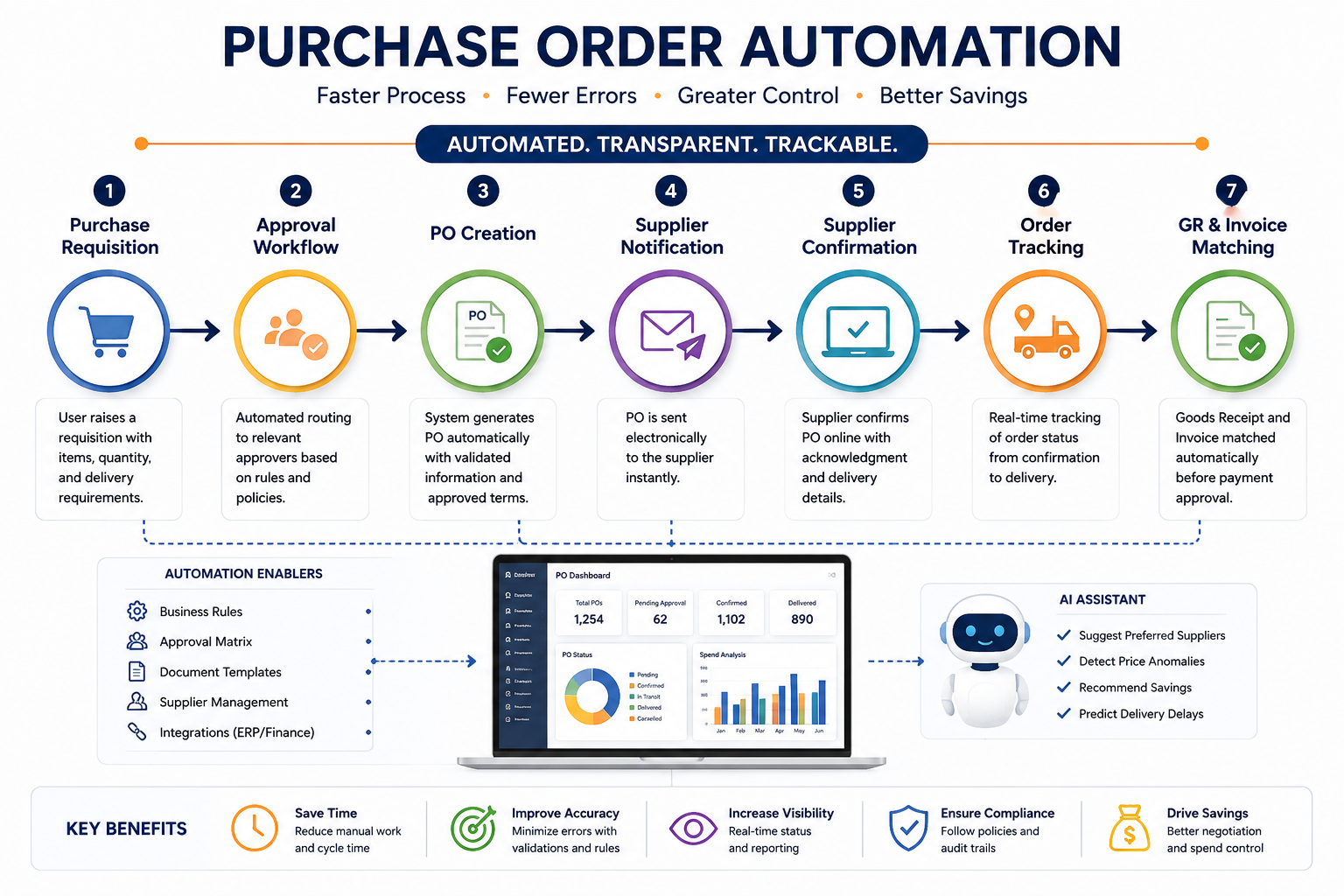
Walk into most Malaysian procurement departments and you'll find the same ritual. Someone needs to buy something. They email a request. Someone else copies it into a form. The form waits in an inbox for approval. It gets approved (eventually), retyped into the finance system, printed, signed, scanned, and emailed to the supplier — who then retypes it into their system. Total elapsed time: three to seven days. Total value added by the humans in that chain: approximately zero.
That ritual is what purchase order automation replaces. Not the decisions — the retyping, the chasing, and the waiting.
What PO automation actually is
Purchase order automation is software that takes a purchase requisition and carries it through to a delivered, invoiced, and matched order with as little manual touch as possible. In practice, a properly automated flow looks like this:
Requisition — the requester picks items from an approved catalogue with pre-negotiated pricing, instead of describing what they want in an email.
Approval routing — the request goes automatically to the right approver based on amount, category, department, and budget line. No forwarding. No "who signs off on this?"
PO generation and transmission — an approved requisition becomes a PO instantly and lands in the supplier's system electronically.
Receiving and matching — goods received are logged against the PO, and the supplier's invoice is matched two- or three-way (PO, receipt, invoice) automatically. Exceptions get flagged; everything else flows straight to payment.
The decision points remain human. Everything between them stops being human.
The cost of staying manual
Industry benchmarks from the likes of APQC and Ardent Partners consistently put the fully loaded cost of processing a manual PO in the range of USD 50–150 per order once you account for labour, errors, and rework — against single-digit dollars for automated ones. But for most enterprises the per-PO cost is the smallest of the four leaks:
Cycle time. Manual approval chains routinely add 3–7 days per order. For operational purchases — spare parts, medical supplies, site consumables — that delay is not an admin inconvenience; it's downtime, stockouts, and emergency purchases at spot prices.
Maverick spend. When the official process takes a week, staff go around it. They buy off-contract, off-catalogue, and off-budget, and procurement finds out when the invoice arrives. Off-contract purchases typically cost 10–20% more than negotiated rates, and every one of them is invisible until it's too late to control.
Matching failures. Manual three-way matching is where finance teams go to suffer. Mismatched quantities, price discrepancies, missing delivery orders — each exception costs 20–30 minutes of investigation. Automated matching clears the clean 90% untouched and surfaces only the genuine exceptions.
Audit exposure. When approvals live in email threads and WhatsApp screenshots, every audit becomes an archaeology project. For GLCs and public-listed companies answering to internal audit, MACC compliance frameworks, and board procurement committees, an unbroken digital approval trail isn't a nice-to-have — it's the difference between a two-day audit query and a two-month one.
The Malaysian angle: e-Invoicing changed the maths
Until recently, PO automation in Malaysia was a pure efficiency argument. LHDN's e-Invoicing mandate changed that. With the phased rollout now covering effectively all businesses, every supplier invoice is already a structured digital document flowing through MyInvois.
This creates an odd asymmetry in companies that haven't automated: the invoice side of the transaction is digital by law, while the order side — the PO it should match against — is still a PDF generated from a spreadsheet. You have machine-readable invoices being manually matched against human-readable orders. The hard half of the digitisation was mandated for you; leaving the easy half manual means paying compliance costs while capturing none of the efficiency.
Enterprises that connect PO data to e-invoice validation get automatic three-way matching against LHDN-validated documents. Those that don't are running a 2026 compliance stack on a 2010 process.
What good looks like: five numbers to track
If you automate and can't measure the difference, you haven't automated — you've bought software. The metrics that matter:
PO cycle time (requisition to supplier receipt): target under 24 hours for catalogue purchases.
Touchless PO rate: the percentage of orders that flow requisition-to-transmission with zero manual intervention. Mature programmes exceed 70%.
Catalogue/contract compliance: percentage of spend on pre-negotiated terms. Every point of improvement here is direct margin.
First-time match rate: invoices that match PO and receipt automatically. Below 85%, your master data needs work before your software does.
Emergency purchase frequency: the truest measure of whether your process is fast enough that people actually use it.
How to start without a transformation programme
The classic failure mode is treating PO automation as a module inside a multi-year ERP overhaul — which means the benefits arrive in year three, if the project survives. The pattern that works is narrower:
Start with one category and one approval flow. Pick a high-volume, low-complexity category — office supplies, MRO, pantry and cleaning consumables. Put it on a catalogue, wire up the approval matrix, and run it for ninety days. You'll surface every master-data and policy gap at small scale, where fixing them is cheap.
Fix the approval matrix before the software. Most "automation" delays are actually governance delays: nobody has written down who approves what, at which threshold, in whose absence. Software can only route rules that exist.
Punch out, don't rebuild. If your suppliers already run digital catalogues, connect to them rather than maintaining your own item master. Catalogue maintenance is where internal procurement systems go to die.
Expand by spend, not by module. Once the first category runs touchless, add the next. Momentum and internal credibility compound; big-bang launches don't.
The bottom line
Purchase order automation is not a moonshot. It's the removal of retyping from a process your company runs thousands of times a year, and it pays back in months, not years. The technology is commoditised, the compliance environment now assumes it, and your competitors' procurement teams are either already touchless or getting there.
The only expensive option left is the status quo.
Lapasar Research — Procurement Research & Insights. Lapasar's Enterprise Procurement platform connects Malaysian enterprises and GLCs to over 2 million SKUs with automated requisition-to-PO workflows.