
How Procurement Impacts Profitability: Why Smart Purchasing Drives Business Growth
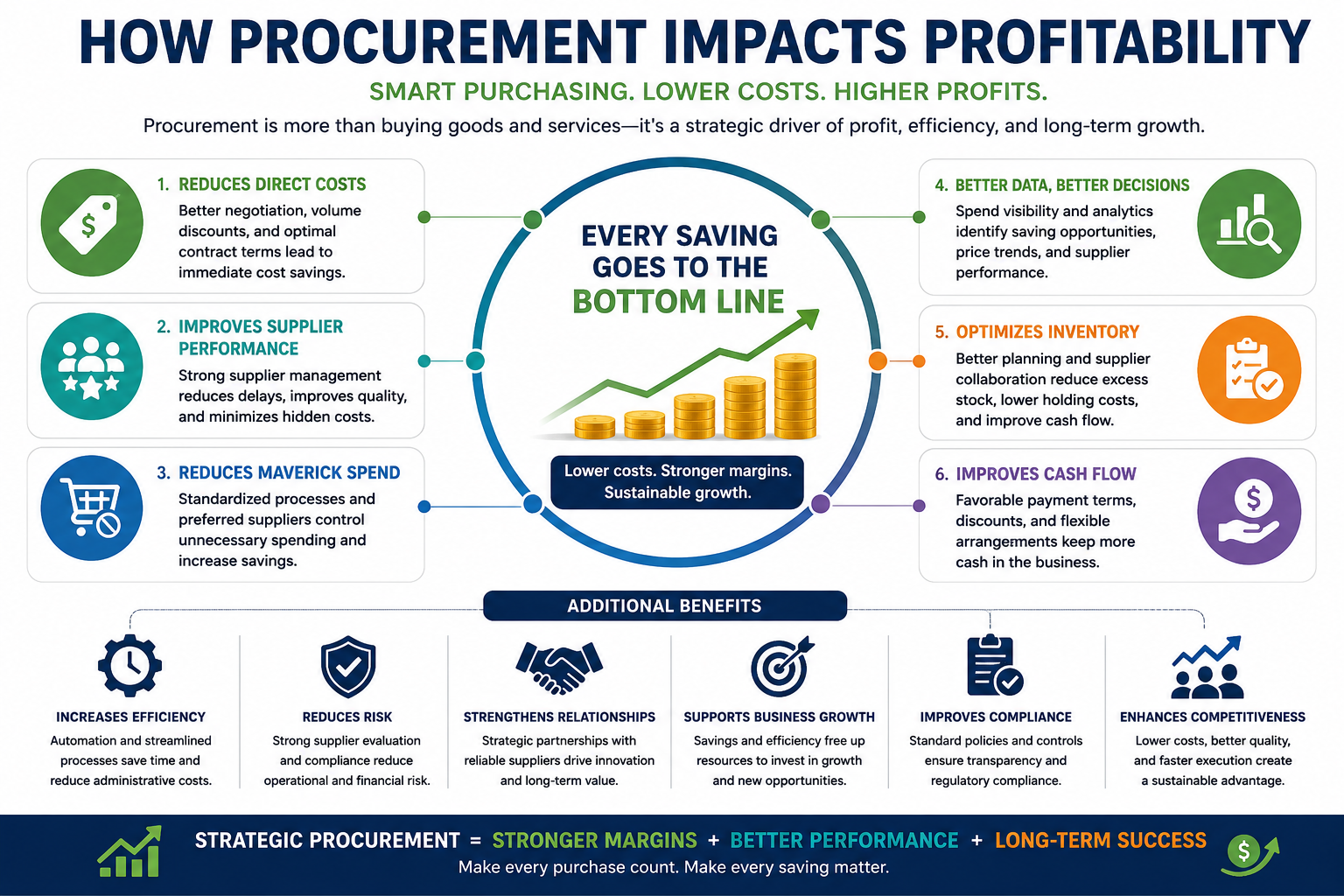
When businesses think about increasing profits, the conversation usually revolves around increasing sales. While revenue growth is important, there’s another area that can improve profitability much faster—and that’s procurement.
Every ringgit saved through smarter purchasing flows directly to the bottom line. Unlike generating additional sales, which often requires marketing, sales commissions, logistics, and operational costs, procurement savings have an immediate impact on profit.
This is why leading organisations now view procurement as a strategic business function rather than simply an administrative department.
Profit Doesn’t Just Come From Selling More
Consider this simple example.
A company generates RM100 million in annual revenue with a 10% profit margin.
Annual profit: RM10 million
If procurement manages to reduce overall purchasing costs by just 3%, and annual procurement spend is RM50 million, the company immediately saves:
RM1.5 million
That RM1.5 million goes almost entirely to the bottom line.
To generate the same RM1.5 million through sales alone, the company might need to generate RM15–20 million in additional revenue depending on its profit margins.
This illustrates why procurement often delivers one of the highest returns on investment within an organisation.
Procurement Reduces Direct Costs
The most obvious impact is cost reduction.
Effective procurement teams negotiate:
Better pricing Volume discounts Long-term contracts Payment terms Freight savings Consolidated purchasing
Even small percentage improvements across thousands of purchases create significant annual savings.
Modern procurement teams also continuously benchmark suppliers to ensure pricing remains competitive instead of automatically renewing existing contracts.
Better Supplier Management Improves Business Performance
The cheapest supplier isn’t always the most profitable supplier.
Late deliveries, inconsistent quality, poor communication, and unreliable service all create hidden costs such as:
Production delays Emergency purchases Project overruns Customer dissatisfaction * Additional labour costs
Strategic procurement focuses on supplier performance—not just price.
Companies that regularly monitor supplier KPIs often experience fewer operational disruptions and lower total procurement costs over time.
Procurement Reduces Maverick Spending
One of the biggest profit leaks in many organisations is uncontrolled purchasing.
Departments buying from different suppliers for similar products often leads to:
Duplicate vendors Inconsistent pricing Lost volume discounts Poor spend visibility * Increased administrative workload
This is commonly known as maverick spend.
Implementing procurement policies, preferred supplier lists, and approval workflows helps organisations standardise purchasing while maintaining governance.
The result is greater control over company spending and higher profitability.
Better Data Leads to Better Decisions
Modern procurement platforms provide visibility into organisational spending.
Instead of asking:
“How much are we spending?”
Businesses can answer:
Which suppliers receive the highest spend? Which categories are growing fastest? Where are prices increasing? Which departments spend the most? * Which suppliers consistently underperform?
With accurate procurement analytics, organisations can identify savings opportunities that would otherwise remain hidden.
Data-driven procurement turns purchasing from a reactive process into a proactive business strategy.
Inventory Optimisation Saves Money
Holding excessive inventory ties up working capital.
Buying too little creates stock shortages and operational delays.
Strategic procurement balances both.
By forecasting demand and improving supplier collaboration, businesses can:
Reduce excess inventory Lower warehousing costs Minimise obsolete stock Improve cash flow * Increase inventory turnover
These improvements contribute directly to stronger financial performance.
Procurement Improves Cash Flow
Profitability isn’t just about earning more—it’s also about managing cash effectively.
Procurement teams negotiate payment terms that improve working capital, such as:
Extended payment periods Early payment discounts Flexible billing arrangements Consolidated invoicing
Better cash flow provides businesses with greater flexibility to invest in growth, hire talent, or respond to market changes without relying heavily on external financing.
Digital Procurement Increases Efficiency
Manual procurement processes consume valuable time.
Employees spend hours:
Requesting quotations Chasing approvals Comparing suppliers Processing purchase orders * Reconciling invoices
Digital procurement platforms automate many of these tasks through:
Online supplier catalogues Automated approval workflows Budget controls Real-time reporting Purchase tracking Electronic documentation
Automation reduces administrative costs while allowing procurement professionals to focus on strategic initiatives rather than paperwork.
Procurement Creates Long-Term Competitive Advantage
Businesses with mature procurement functions typically enjoy:
Lower operating costs Stronger supplier relationships Better purchasing visibility Reduced operational risk Faster purchasing cycles Higher compliance * Improved customer satisfaction
These advantages compound over time, creating sustainable improvements in profitability and business performance.
Final Thoughts
Procurement has evolved far beyond simply purchasing goods and services. It has become a strategic function that directly influences profitability, operational efficiency, cash flow, and long-term business resilience.
Organisations that invest in smarter procurement processes, stronger supplier relationships, and digital procurement technology are better positioned to reduce costs, improve governance, and increase margins.
In an increasingly competitive market, every purchasing decision matters. Businesses that treat procurement as a strategic investment—not just an operational necessity—will be better equipped to protect profits and drive sustainable growth.