
Benefits of a B2B Marketplace for Malaysian Businesses
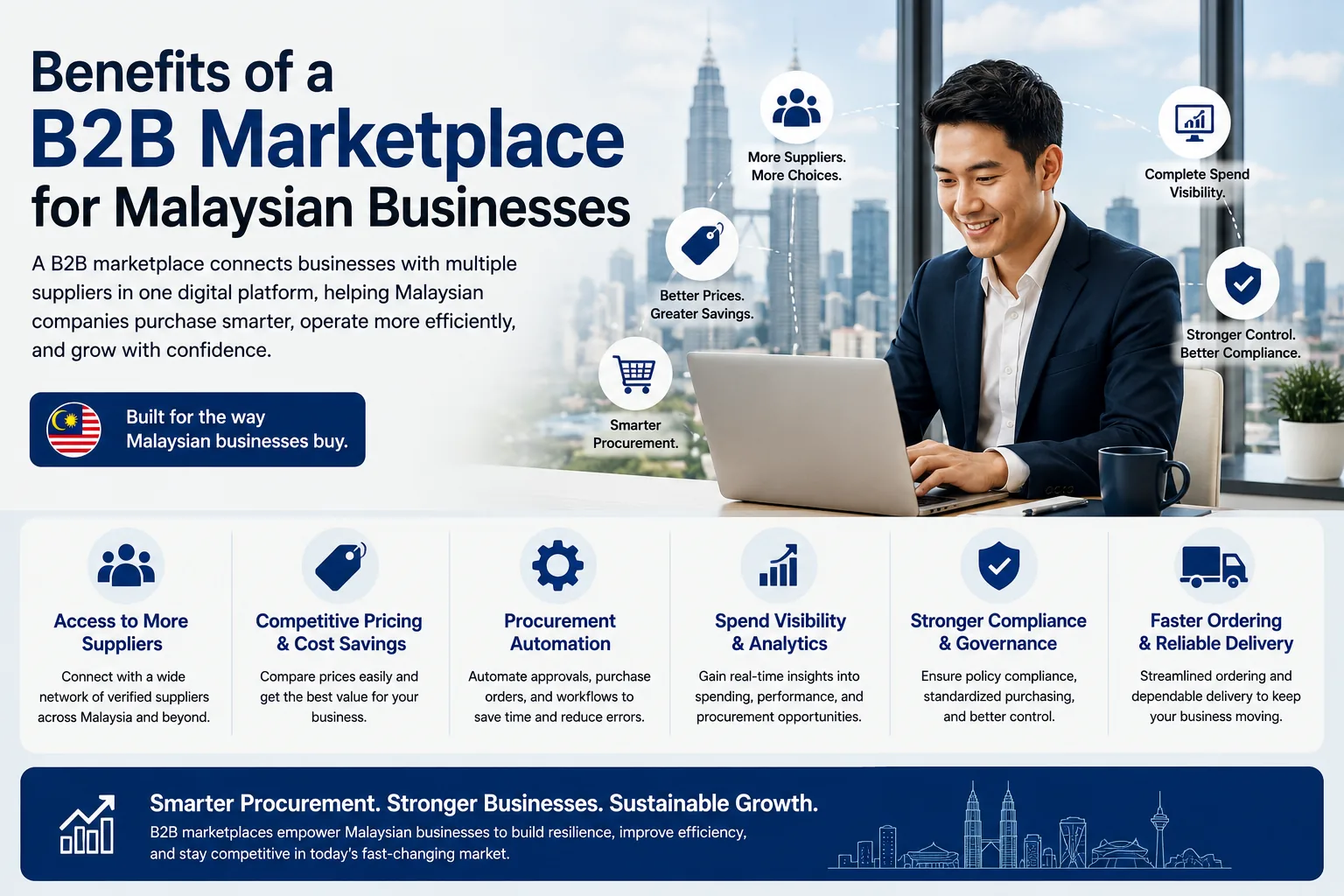
The way Malaysian businesses purchase products and services is rapidly evolving. For decades, procurement relied heavily on phone calls, sales representatives, manual quotations, physical catalogues, and long-standing supplier relationships. These traditional purchasing methods continue to exist. Yet businesses across Malaysia are increasingly turning to B2B marketplaces to improve procurement efficiency, reduce costs, and gain greater spend visibility.
A B2B marketplace is a digital platform that connects businesses with multiple suppliers through a centralized procurement environment. Instead of relying on a single distributor or managing many supplier relationships independently, businesses gain one platform. There they can discover products, compare suppliers, place orders, and manage procurement activities.
Malaysian businesses face rising operational costs, increasing competition, and growing pressure to improve efficiency. Against this backdrop, the benefits of a B2B marketplace have become increasingly valuable.
Access to a Broader Supplier Network
One of the most significant advantages of a B2B marketplace is access to a broader supplier network. Traditionally, businesses often relied on a limited number of suppliers that they had worked with for years. While these relationships remain important, they can restrict visibility into alternative suppliers, pricing options, and product availability. A B2B marketplace gives businesses access to a much larger pool of suppliers, allowing procurement teams to evaluate multiple options and make more informed purchasing decisions.
Greater Price Transparency
Price transparency is another major benefit. In many traditional procurement environments, buyers must contact multiple suppliers individually to request quotations and compare pricing. This process can be time-consuming and may not always provide complete visibility into market rates. Through a B2B marketplace, businesses can compare products and suppliers more efficiently, helping them identify cost-saving opportunities and secure better value for money.
Procurement Efficiency for Malaysian SMEs
For Malaysian SMEs, procurement efficiency is often a critical challenge. SMEs make up the vast majority of business establishments in Malaysia, according to the Department of Statistics Malaysia. Many small and medium-sized businesses operate with lean teams that must handle multiple responsibilities. Procurement activities such as sourcing suppliers, obtaining quotations, managing approvals, and tracking orders can consume valuable time and resources. A B2B marketplace simplifies these processes by centralizing procurement activities in a single platform. Businesses can then focus on growth and customer service rather than administrative purchasing tasks.
Streamlined Day-to-Day Purchasing
When procurement moves online, the day-to-day experience improves noticeably for operational teams:
- Products are searchable by category, brand, or specification
- Repeat orders are placed in minutes without re-negotiating each purchase
- Approval workflows run digitally without email chains
- Delivery tracking is available in real time
- Invoices and purchase records are accessible in one place
These improvements free employees to focus on business-critical work rather than procurement administration.
Reducing Total Procurement Costs
The ability to reduce procurement costs is one of the strongest reasons businesses adopt B2B marketplaces. Access to multiple suppliers creates competition within the marketplace, which can help businesses secure more competitive pricing. Procurement teams also gain greater visibility into purchasing patterns. This helps them identify opportunities for consolidation, standardization, and spending optimization.
Beyond product pricing, businesses also reduce costs by minimizing administrative overhead. Digital procurement workflows eliminate many of the manual tasks associated with traditional purchasing, reducing the time and resources required to manage procurement operations.
Building Supply Chain Resilience
Supply chain disruption has become an increasingly important concern for Malaysian businesses. Over-reliance on a single supplier or a narrow group of vendors can leave organizations vulnerable when market conditions change. A B2B marketplace reduces supply chain risk by giving businesses access to a diverse supplier base. When one supplier is unable to fulfill an order, alternative suppliers within the marketplace can often provide continuity.
This resilience is particularly valuable for organizations that source critical operational products or services with tight lead time requirements. The ability to switch suppliers quickly without renegotiating contracts from scratch can prevent significant disruption to operations.
Supporting Malaysia's Digital Economy Goals
Malaysia's national digital economy agenda, championed by the Malaysia Digital Economy Corporation (MDEC), has prioritized the adoption of digital tools and platforms across business sectors. B2B marketplaces align directly with this goal by helping businesses digitize one of their most important operational functions. For businesses seeking to participate in Malaysia's growing digital economy, adopting a B2B marketplace represents a practical and high-impact step forward.
Organizations that modernize procurement through a B2B marketplace often report clear gains. These include improved operational efficiency, stronger financial controls, better supplier relationships, and greater agility in responding to market changes. Lapasar's enterprise procurement research documents these outcomes from Malaysian organisations that have made this transition. These benefits collectively strengthen the competitive position of Malaysian businesses in both local and regional markets.