
Long Tail Spend Management: The Hidden Opportunity for Procurement Teams
Most procurement teams focus their attention on strategic suppliers, major contracts, and high-value purchases. While these categories often represent the majority of spend, they usually account for a surprisingly small percentage of procurement transactions.
The real challenge lies elsewhere: long tail spend.
What is Long Tail Spend?
Long tail spend refers to the thousands of low-value purchases made across an organization. These can include:
- Office supplies
- Maintenance and repair items
- IT peripherals
- Safety equipment
- Pantry supplies
- Tools and consumables
- Ad-hoc operational purchases
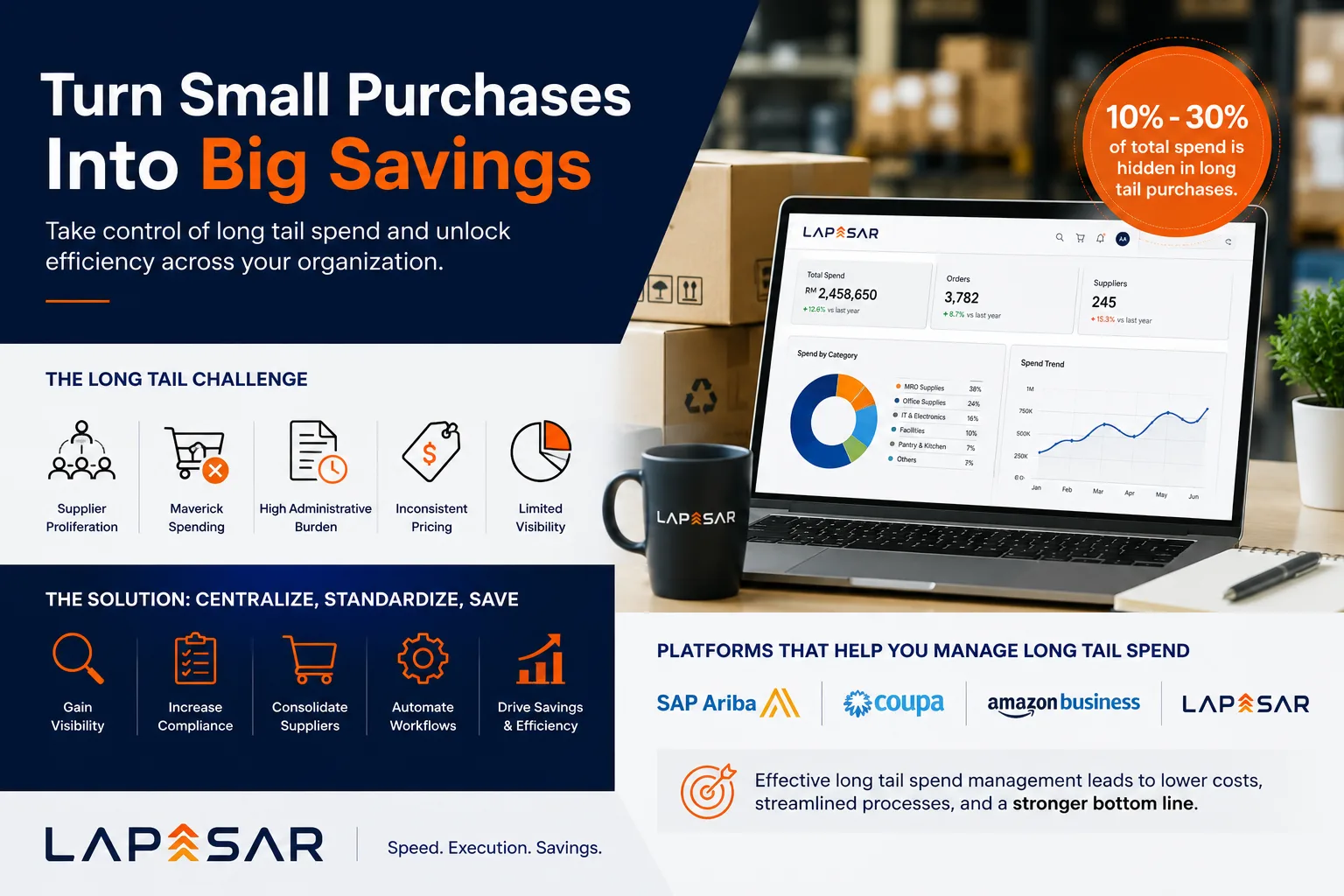
Individually, these purchases may seem insignificant. Collectively, however, they often account for 10% to 30% of total procurement spend and an even larger percentage of procurement workload.
Because these purchases are fragmented across many suppliers and departments, organizations often struggle with:
- Limited visibility
- Off-contract spending
- Duplicate suppliers
- Manual processing
- Poor pricing consistency
- High administrative costs
In many cases, the cost of processing the purchase exceeds the value of the item itself.
Why Long Tail Spend Matters
Long tail spend is frequently overlooked because procurement teams are naturally drawn to larger savings opportunities. However, unmanaged long tail spend creates several hidden costs:
Supplier Proliferation
Organizations can end up managing hundreds or even thousands of suppliers for relatively small purchases, increasing onboarding, compliance, and payment workloads.
Maverick Spending
Employees often purchase directly from suppliers without going through approved procurement channels, reducing control and visibility.
Administrative Burden
Processing a RM100 purchase order can require the same approvals and paperwork as a RM100,000 purchase order.
Missed Savings
Without centralized purchasing, different departments may pay different prices for identical products.
Modern Approaches to Long Tail Spend Management
Leading organizations are adopting digital procurement platforms to simplify and automate long tail purchasing. Lapasar's research on AI and long-tail procurement explores how machine learning and intelligent automation are accelerating this shift, reducing the cost and complexity of managing this spend category at scale.
The objective is straightforward:
- Consolidate suppliers
- Standardize purchasing
- Improve visibility
- Reduce processing costs
- Capture savings
Several procurement platforms help organizations achieve this.
SAP Ariba
SAP Ariba offers a comprehensive procurement ecosystem with supplier management, sourcing, and purchasing capabilities. It is commonly used by large enterprises seeking global supplier connectivity and governance.
Coupa
Coupa provides spend management and procurement solutions focused on visibility, compliance, and spend optimization. Its strength lies in analytics and enterprise spend control.
Amazon Business
Amazon Business is increasingly used for tail spend in markets where it operates, offering a familiar interface and a broad product range. However, it is not available in Malaysia and does not address the supplier management needs of Malaysian enterprises.
Lapasar
For Malaysian businesses, Lapasar offers a purpose-built B2B procurement marketplace that directly addresses long tail spend. It offers over 2 million SKUs, more than 10,000 verified suppliers, and Peninsular Malaysia fulfillment infrastructure. This lets organizations consolidate tail spend into a single, managed purchasing channel.
Key capabilities include procurement automation, approval workflows, spend reporting, and next-day delivery across operational and MRO categories. All of this sits within a platform built specifically for Malaysian enterprise and SME procurement.
How to Get Started with Long Tail Spend Management
Gaining control of long tail spend does not require a large transformation program. The most effective starting point is to identify the categories where fragmented purchasing is highest. From there, consolidate those categories onto a single procurement platform and apply spend controls to encourage channel compliance.
Over time, organizations that take this approach see measurable results. These include a lower supplier count, reduced processing costs, better pricing consistency, and improved spend visibility across procurement operations.
For procurement teams ready to address the hidden opportunity in their tail spend, a modern B2B marketplace provides the fastest path to measurable results.