
Procurement Cost Reduction Strategies: 10 Practical Ways to Lower Business Spending
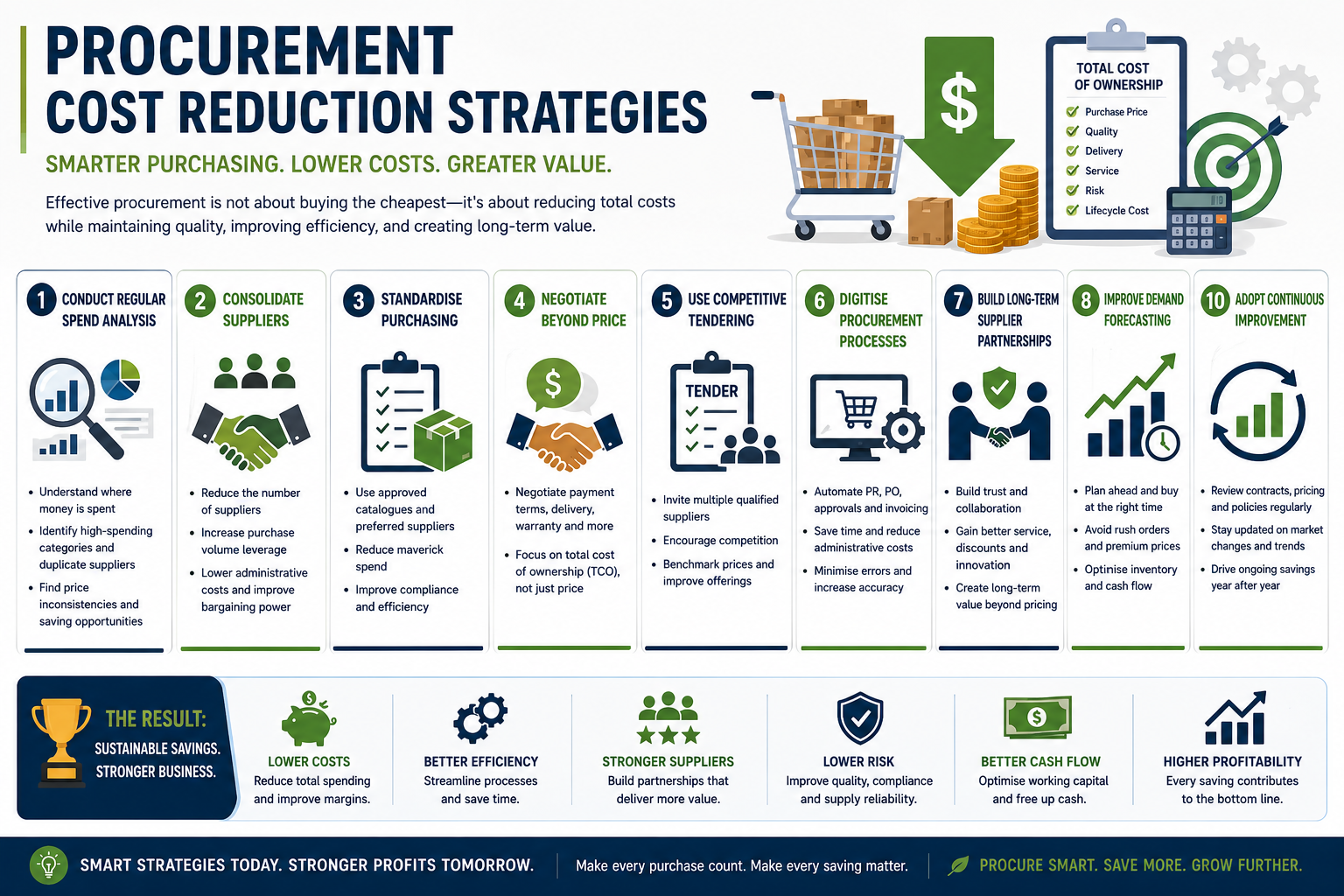
Every business wants to reduce costs, but cutting expenses without a clear strategy can often lead to poor quality, unreliable suppliers, and operational disruptions.
Successful procurement cost reduction isn’t about paying the lowest price. Instead, it’s about reducing the Total Cost of Ownership (TCO) while improving supplier performance, efficiency, and long-term value.
Modern procurement teams focus on smarter purchasing decisions that create sustainable savings rather than short-term cost cuts.
Here are ten proven procurement cost reduction strategies that organisations can implement today.
- Conduct Regular Spend Analysis
The first step to reducing procurement costs is understanding where your money goes.
Many organisations purchase similar products from multiple suppliers without realising how fragmented their spending has become.
A spend analysis helps identify:
High-spending categories Duplicate suppliers Purchasing trends Price inconsistencies * Cost-saving opportunities
With clear visibility into procurement data, businesses can make informed purchasing decisions instead of relying on assumptions.
⸻
- Consolidate Suppliers
Working with too many suppliers often increases costs.
Multiple vendors supplying similar products can result in:
Different pricing Higher administrative workload More invoices Reduced bargaining power
Supplier consolidation allows businesses to negotiate better pricing through higher purchase volumes while simplifying supplier management.
Fewer strategic suppliers often lead to stronger relationships and better service levels.
⸻
- Standardise Purchasing
When every department purchases independently, costs quickly increase.
Standardising procurement through approved product catalogues and preferred suppliers helps organisations:
Eliminate duplicate purchases Improve compliance Reduce maverick spending Increase purchasing efficiency
Standardisation also makes budgeting more predictable.
⸻
- Negotiate Beyond Price
Many procurement professionals focus only on product pricing.
However, significant savings can also come from negotiating:
Payment terms Delivery charges Warranty periods Return policies Installation costs Maintenance agreements
The lowest unit price does not always deliver the lowest total procurement cost.
⸻
- Use Competitive Tendering
Inviting multiple qualified suppliers to compete encourages competitive pricing and better service offerings.
Competitive sourcing also provides valuable market intelligence by revealing:
Current market rates Supplier capabilities New product alternatives Service improvements
Regular supplier benchmarking ensures pricing remains competitive over time.
⸻
- Digitise Procurement Processes
Manual procurement processes are expensive.
Employees spend hours:
Requesting quotations Sending emails Processing purchase orders Following up approvals * Matching invoices
Digital procurement platforms automate these repetitive tasks, reducing administrative costs while improving purchasing speed and accuracy.
Automation also reduces human errors that can lead to unnecessary expenses.
⸻
- Build Long-Term Supplier Partnerships
Cost reduction isn’t always achieved by switching suppliers every year.
Reliable suppliers who understand your business often provide:
Better service Priority stock allocation Faster deliveries Volume discounts * Innovation opportunities
Strategic supplier relationships create long-term value that extends beyond pricing.
⸻
- Improve Demand Forecasting
Emergency purchases are among the most expensive procurement activities.
Poor planning often leads to:
Rush deliveries Higher product prices Limited supplier choices Operational downtime
Better forecasting enables procurement teams to purchase at the right time, negotiate better pricing, and reduce inventory costs.
⸻
- Monitor Supplier Performance
Poor supplier performance creates hidden costs that many organisations overlook.
Track supplier KPIs such as:
On-time delivery Product quality Order accuracy Response time * Service reliability
High-performing suppliers reduce operational disruptions, returns, and emergency purchases.
⸻
- Adopt a Continuous Improvement Mindset
Procurement cost reduction should never be a one-time exercise.
Markets change. Supplier prices fluctuate. New technologies emerge.
Successful procurement teams regularly review:
Supplier contracts Category spending Market pricing Procurement policies * Process efficiency
Continuous improvement ensures cost savings remain sustainable year after year.
⸻
Common Procurement Cost Reduction Mistakes
Many businesses unintentionally increase costs by:
Choosing suppliers based only on price Ignoring supplier performance Allowing uncontrolled purchasing Managing procurement manually Failing to analyse spend data Not reviewing supplier contracts regularly
Avoiding these mistakes can deliver substantial savings without sacrificing quality.
⸻
Final Thoughts
Reducing procurement costs is not about cutting corners—it is about making smarter purchasing decisions.
Businesses that invest in spend visibility, supplier management, procurement automation, and strategic sourcing consistently achieve lower operating costs while improving efficiency and supplier performance.
As organisations face increasing pressure to control expenses, procurement has become one of the most effective functions for protecting margins and driving long-term profitability. Every purchasing decision represents an opportunity to reduce costs, improve value, and strengthen business performance.