
What Is a B2B Marketplace?
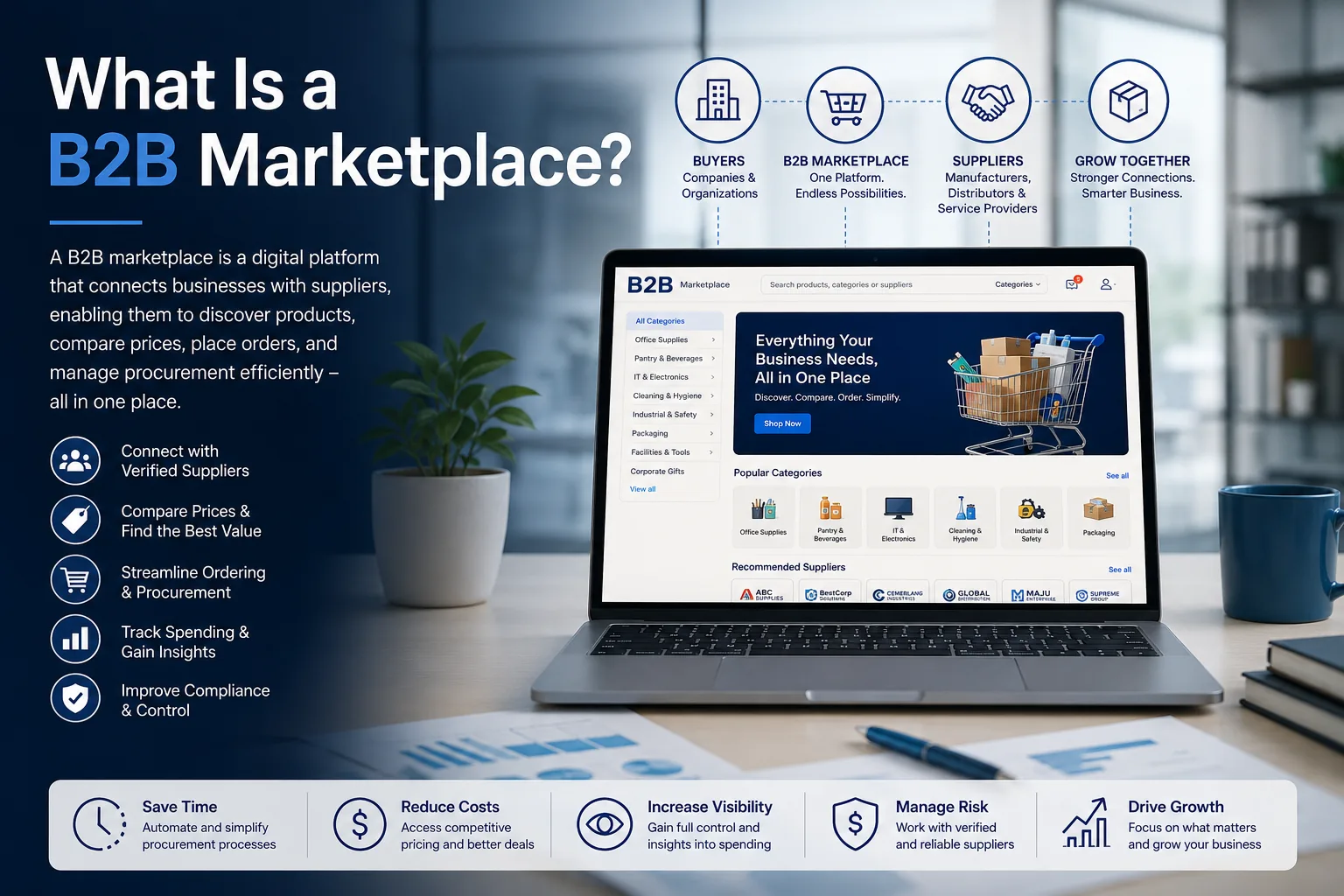
A B2B marketplace, short for Business-to-Business marketplace, is a digital platform that connects businesses with suppliers, manufacturers, distributors, and service providers. It enables companies to discover products, compare suppliers, request quotations, place orders, and manage procurement activities through a centralized online environment.
In the past, business purchasing was largely conducted through phone calls, emails, physical catalogues, sales representatives, and long-standing supplier relationships. These methods still exist today. But modern organizations increasingly rely on B2B marketplaces to simplify purchasing, improve transparency, and access a broader network of suppliers. As businesses continue their digital transformation journey, B2B marketplaces have become an essential part of procurement and supply chain management strategies.
How a B2B Marketplace Works
At its core, a B2B marketplace brings together buyers and sellers on a single platform. Suppliers can showcase their products and services, while buyers can browse available options, compare pricing, evaluate suppliers, and make informed purchasing decisions. This creates a more efficient and competitive procurement environment. Businesses can source what they need without spending excessive time searching for suppliers or negotiating individual agreements.
One of the key reasons B2B marketplaces have gained popularity is their ability to reduce procurement complexity. Many organizations purchase products and services from dozens or even hundreds of vendors. Managing these relationships manually can be time-consuming and difficult to scale. A B2B marketplace centralizes these activities, making it easier for businesses to manage spending, track purchases, and maintain visibility across their procurement operations.
Key Features Designed for Business Purchasing
Unlike consumer-focused eCommerce platforms, B2B marketplaces are designed specifically for business purchasing requirements. Business buyers often need features built for procurement. These include bulk ordering, customized pricing, credit terms, approval workflows, purchase order management, supplier management, and procurement reporting. These capabilities allow organizations to maintain procurement controls while still benefiting from the convenience of online purchasing.
Procurement Controls Built In
A well-designed B2B marketplace includes features that help organizations enforce procurement policies:
- Role-based access controls ensure only authorized personnel can place orders
- Approval workflows enforce budget controls before purchases are confirmed
- Spend limits can be configured by department, category, or user
- All purchasing activity is logged for audit and compliance purposes
- Reporting tools give finance teams visibility into spending by category, supplier, or time period
These controls make a B2B marketplace a complete procurement management environment, not simply an online catalog.
B2B Marketplaces vs Consumer eCommerce
While B2B and B2C eCommerce share some surface-level similarities — product listings, search, and digital checkout — they serve fundamentally different purchasing needs. B2B procurement typically involves larger order quantities, longer purchasing cycles, multiple decision-makers, and stricter compliance requirements. B2B marketplaces are built to accommodate these dynamics, while consumer platforms are optimized for individual, single-transaction purchases.
The distinction matters for businesses evaluating procurement tools. A consumer platform adapted for business use rarely provides the supplier management, spend reporting, or workflow automation that procurement teams need. A purpose-built B2B marketplace addresses these requirements natively.
Benefits for Business Buyers
Supplier discovery is a major advantage of a B2B marketplace. Traditionally, finding new suppliers required extensive research, industry contacts, trade exhibitions, or referrals. A marketplace simplifies this process by providing access to a large network of verified suppliers within a single platform. This increases competition among vendors and gives buyers more choices when sourcing products or services. As a result, businesses are often able to secure better pricing, improved service levels, and more reliable supply options.
B2B marketplaces also play an important role in procurement cost optimization. By providing visibility into multiple suppliers and pricing options, organizations can make more informed purchasing decisions. They can avoid overpaying and identify opportunities to consolidate spending with preferred suppliers at negotiated rates.
Benefits for Suppliers
For suppliers, joining a B2B marketplace provides access to a large and qualified base of business buyers. Rather than investing heavily in their own sales and marketing infrastructure, suppliers can reach enterprise procurement teams through the marketplace's established platform. This lowers the cost of customer acquisition and allows suppliers to focus on fulfillment and product quality.
A well-run B2B marketplace also offers suppliers faster payment cycles, transparent dispute resolution, and tools to manage orders and inventory efficiently. This makes it a commercially attractive channel alongside direct sales.
The Role of B2B Marketplaces in Supply Chain Strategy
Global supply chains are becoming more complex, and businesses demand greater resilience and visibility. B2B marketplaces have emerged as a strategic layer of the procurement ecosystem. By consolidating supplier relationships onto a single platform, organizations gain new oversight and agility. They can respond to disruption, capture savings, and align purchasing decisions with broader business objectives.
For businesses seeking to modernize their procurement operations, a B2B marketplace provides an immediate, practical, and scalable starting point. Lapasar's procurement research hub covers the key trends, frameworks, and evidence driving this shift across Malaysian enterprises.