
B2B Marketplace Trends in 2026
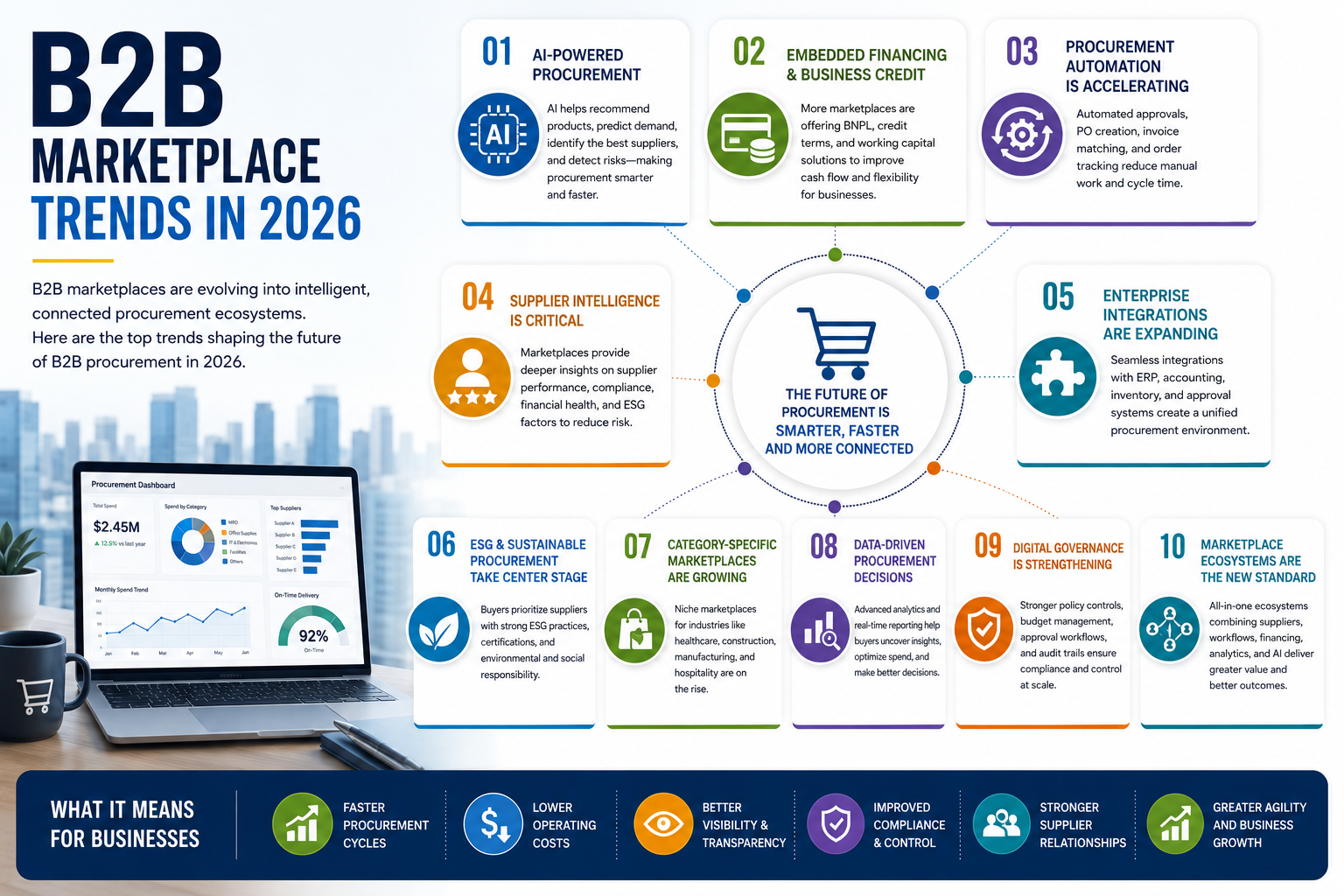
Over the past decade, B2B marketplaces have transformed how businesses buy and sell products and services. What began as digital catalogs and supplier directories has evolved into sophisticated procurement platforms that support sourcing, supplier management, spend control, and workflow automation.
In 2026, the role of B2B marketplaces is expanding even further.
Organizations are no longer looking for platforms that simply facilitate transactions. They want intelligent procurement ecosystems that help them reduce costs, improve compliance, mitigate risk, and drive operational efficiency.
As technology advances and procurement expectations increase, several key trends are reshaping the B2B marketplace landscape.
⸻
- AI-Powered Procurement Becomes Mainstream
Artificial Intelligence is rapidly becoming one of the most significant drivers of innovation in B2B marketplaces.
Modern marketplaces are increasingly using AI to:
Recommend alternative products Suggest preferred suppliers Predict purchasing patterns Automate sourcing decisions Detect spending anomalies Improve product search accuracy
Instead of manually reviewing thousands of products and suppliers, procurement teams can leverage AI to identify the most suitable purchasing options within seconds.
In 2026, AI is becoming a standard feature rather than a competitive advantage.
⸻
- Embedded Financing and Business Credit Expansion
Cash flow remains a major concern for businesses, particularly SMEs.
As a result, many B2B marketplaces are integrating financial services directly into their platforms.
Popular financing features include:
Buy Now Pay Later (BNPL) for businesses Credit terms Working capital financing Invoice financing * Consolidated billing
By embedding financial solutions into the procurement process, marketplaces are helping businesses manage cash flow more effectively while increasing purchasing flexibility.
⸻
- Procurement Automation Is Accelerating
Procurement teams continue to face pressure to do more with fewer resources.
To address this challenge, B2B marketplaces are increasingly automating procurement workflows such as:
Purchase approvals Supplier onboarding Order processing Invoice matching Goods receipt tracking Budget enforcement
Automation reduces manual workload while improving accuracy and compliance.
Organizations that embrace procurement automation are often able to process purchases faster while lowering operational costs.
⸻
- Supplier Intelligence Is Becoming Critical
Procurement leaders are placing greater emphasis on supplier performance and risk management.
In response, marketplaces are investing heavily in supplier intelligence capabilities.
These include:
Supplier ratings Performance scorecards Compliance verification Financial health monitoring ESG assessments Delivery performance tracking
Corporate buyers increasingly expect marketplaces to provide deeper supplier insights rather than simply listing products.
⸻
- Enterprise Integrations Are Expanding
Large organizations typically operate multiple business systems.
To avoid fragmented processes, businesses are demanding tighter integration between B2B marketplaces and enterprise platforms.
Common integrations include:
ERP systems Procurement platforms Accounting software Inventory management systems * Approval workflow systems
In 2026, seamless data exchange is becoming a key requirement when evaluating procurement technology providers.
⸻
- ESG and Sustainable Procurement Are Growing Priorities
Environmental, Social, and Governance (ESG) initiatives are becoming increasingly important in procurement decisions.
Many organizations are now evaluating suppliers based on factors beyond price alone.
B2B marketplaces are responding by highlighting supplier attributes such as:
Sustainability certifications Environmental compliance Diversity initiatives Ethical sourcing practices * Carbon reduction programs
Procurement teams are using these insights to support corporate sustainability objectives while maintaining supply chain accountability.
⸻
- Category-Specific Marketplaces Are Emerging
While general-purpose marketplaces continue to grow, specialized marketplaces are becoming increasingly popular.
Examples include marketplaces focused on:
Industrial supplies Healthcare procurement Construction materials Hospitality procurement Office and facility management Manufacturing components
These niche platforms often provide deeper category expertise and more specialized supplier networks.
⸻
- Data-Driven Procurement Decisions
Data is becoming one of the most valuable assets in procurement.
Modern marketplaces are investing in advanced analytics capabilities that help buyers understand:
Spending trends Supplier performance Category opportunities Purchasing behavior * Cost-saving opportunities
Procurement leaders are increasingly using marketplace data to support strategic sourcing and business planning decisions.
⸻
- Digital Procurement Governance Is Strengthening
As procurement activity becomes more decentralized, organizations are placing greater emphasis on governance.
B2B marketplaces are introducing stronger controls to help organizations manage procurement risk.
Popular governance features include:
Budget controls Approval workflows Category restrictions Preferred supplier enforcement Audit trails Procurement policy automation
These capabilities allow businesses to scale procurement operations without sacrificing control.
⸻
- Marketplace Ecosystems Are Replacing Traditional Procurement Models
Perhaps the most significant trend is the evolution of B2B marketplaces from transactional platforms into complete procurement ecosystems.
Instead of using separate systems for sourcing, supplier management, purchasing, approvals, and analytics, businesses increasingly want a unified experience.
Leading marketplaces are bringing together:
Product catalogs Supplier networks Workflow automation Financing solutions Analytics Compliance tools * AI capabilities
The result is a more connected and efficient procurement environment.
⸻
What These Trends Mean for Businesses
The procurement function is undergoing one of the most significant transformations in its history.
Organizations that continue relying on manual procurement processes may find themselves at a competitive disadvantage compared to businesses that leverage intelligent procurement platforms.
The key benefits of modern B2B marketplaces include:
Faster procurement cycles Better supplier visibility Improved compliance Reduced operational costs Greater procurement transparency Enhanced decision-making
Businesses that adopt these technologies early will be better positioned to respond to market changes and procurement challenges.
⸻
Conclusion
The B2B marketplace industry is entering a new phase of growth driven by automation, artificial intelligence, embedded finance, supplier intelligence, and integrated procurement ecosystems.
In 2026, marketplaces are no longer simply places to buy products. They are becoming strategic platforms that help organizations manage procurement more efficiently, reduce risk, improve governance, and unlock valuable business insights.
As these trends continue to accelerate, businesses that embrace modern B2B marketplaces will gain a significant advantage through better procurement performance, stronger supplier relationships, and increased operational agility.
The future of procurement is digital, data-driven, and increasingly marketplace-powered.