
Benefits of Procurement Automation
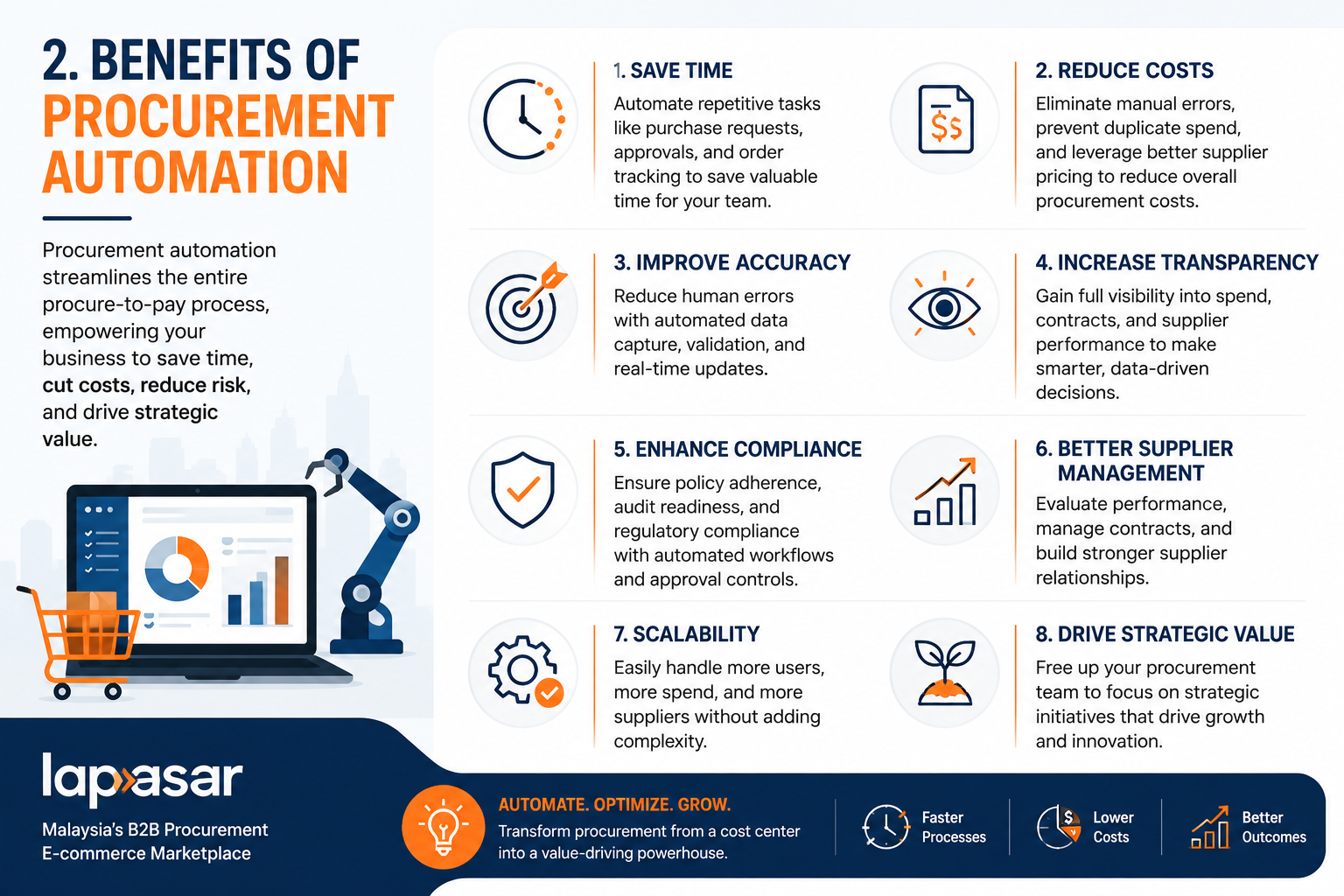
Most procurement departments don't have a strategy problem. They have a time problem.
Walk into the purchasing function of a typical Malaysian enterprise and you'll find capable people spending their days on work that creates zero value: typing purchase requisitions into spreadsheets, emailing PDFs for signatures, calling vendors to ask where an order is, and matching invoices to POs line by line. The strategic work — supplier consolidation, price benchmarking, demand planning — happens in whatever hours are left over. Usually, none are.
Procurement automation attacks that time problem directly. Here is what actually changes.
1. Cycle times collapse from weeks to days
The single most visible benefit. A manual purchase requisition travels by email, sits in inboxes, gets lost, gets re-sent, and waits for a manager who is travelling. In an automated workflow, the requisition routes itself to the right approver based on value, category, and department — with escalation rules if it sits too long.
Organisations that digitise requisition-to-PO typically cut cycle times by more than half, and often far more. For operational purchases — pantry supplies, spare parts, cleaning consumables — the difference between a two-week cycle and a two-day cycle is the difference between planned purchasing and panic purchasing. Panic purchasing is always more expensive.
2. Maverick spend gets engineered out
Maverick spend — employees buying outside approved channels and negotiated contracts — is the silent tax on every procurement budget. It happens not because staff are careless, but because the official process is slower than opening Shopee.
Automation fixes the root cause: it makes the compliant path the easiest path. When employees can raise a request in a catalogue with pre-negotiated pricing and get approval in hours, there is no reason to go around the system. The negotiated rate you fought for in the annual tender actually gets used — on every order, not just the ones procurement happens to see.
3. Every ringgit becomes visible
You cannot manage what you cannot see, and most enterprises genuinely cannot see their long-tail spend. It lives in petty cash claims, departmental credit cards, and one-off vendor invoices scattered across branches and subsidiaries.
An automated platform captures every transaction in one structured dataset: who bought what, from whom, at what price, against which budget. That visibility is the raw material for everything else — supplier consolidation, price benchmarking across branches, budget forecasting, and honest answers to the board's favourite question: where is the money actually going?
For multi-entity groups, this is often the first time group-level spend can be analysed at all.
4. Costs drop — in two different ways
Procurement automation reduces cost through two separate mechanisms, and it's worth keeping them apart:
Process cost. Every manual PO carries an administrative burden — staff time across requisition, approval, ordering, receiving, and invoice matching. Automation cuts the processing cost per transaction dramatically. For an enterprise raising thousands of POs a year, this alone is a meaningful line item.
Price cost. Consolidated, visible spend gives you negotiating leverage you didn't have before. When you can show a supplier your true group-wide volume — instead of fragmented orders from ten branches negotiating separately — pricing conversations change. Spend visibility converts directly into unit-price savings.
Most business cases focus on price savings. In practice, the process savings usually arrive first and are easier to prove.
5. Audit and compliance stop being a fire drill
Malaysian enterprises — especially GLCs, public-listed companies, and regulated industries — live under real governance obligations. In a manual environment, audit season means weeks of reconstructing paper trails: finding the approval email, the quote comparison, the delivery order, the signed invoice.
In an automated system, the audit trail builds itself. Every requisition, approval, exception, and payment is timestamped and immutable. Three-quote requirements, limits of authority, and segregation of duties are enforced by the workflow, not by hoping people remember the policy. Compliance shifts from something you check after the fact to something the system guarantees by design.
6. Supplier relationships get measurably better
This one is counterintuitive — suppliers benefit from your automation too. They get orders in a structured format instead of WhatsApp messages, clear delivery instructions, and faster invoice processing, which means faster payment. On-time payment is the single strongest lever for becoming a preferred customer, and preferred customers get priority stock, better service, and better pricing.
Automation also gives you supplier performance data — OTIF rates, price variance, quality issues — so vendor reviews are based on facts rather than the loudest recent complaint.
7. Your data becomes AI-ready
The benefit almost nobody puts in the business case, and arguably the most important one for the next five years: automation creates the structured procurement data that AI needs to be useful.
AI-driven demand forecasting, anomaly detection, automated tail-spend negotiation, and spend classification all require clean transactional data — item-level, timestamped, categorised. Enterprises running procurement on email and Excel simply don't have it. Every year you delay automation is another year of data you'll never get back. The gap between organisations with five years of structured procurement data and those starting from zero is going to compound.
The honest caveat
Automation amplifies your process — good or bad. Automating a broken approval matrix gives you a faster broken approval matrix. The enterprises that see the biggest returns treat automation as a chance to redesign the process, not just digitise it: fewer approval layers, clearer limits of authority, consolidated supplier panels.
The second caveat: software alone doesn't fulfil orders. A platform can generate a perfect PO in thirty seconds, but if the supplier behind it can't deliver on time and in full, you've automated your way to a very efficient stockout. Procurement automation works best when the workflow layer is paired with reliable supply — verified suppliers, actual inventory, and accountable delivery.
Where to start
You don't automate everything on day one. The highest-return starting point for most Malaysian enterprises is long-tail and operational spend — the thousands of small, frequent purchases that consume disproportionate administrative effort relative to their value. Automate that layer first, prove the cycle-time and compliance gains, then extend upstream into sourcing and contract management.
The enterprises that moved early aren't just processing purchases faster. They're negotiating from better data, passing audits without fire drills, and building the datasets that will power the next decade of AI-driven procurement. The ones still running on email and spreadsheets are paying for that gap every month — they just can't see the invoice.