
Common Challenges in B2B Procurement
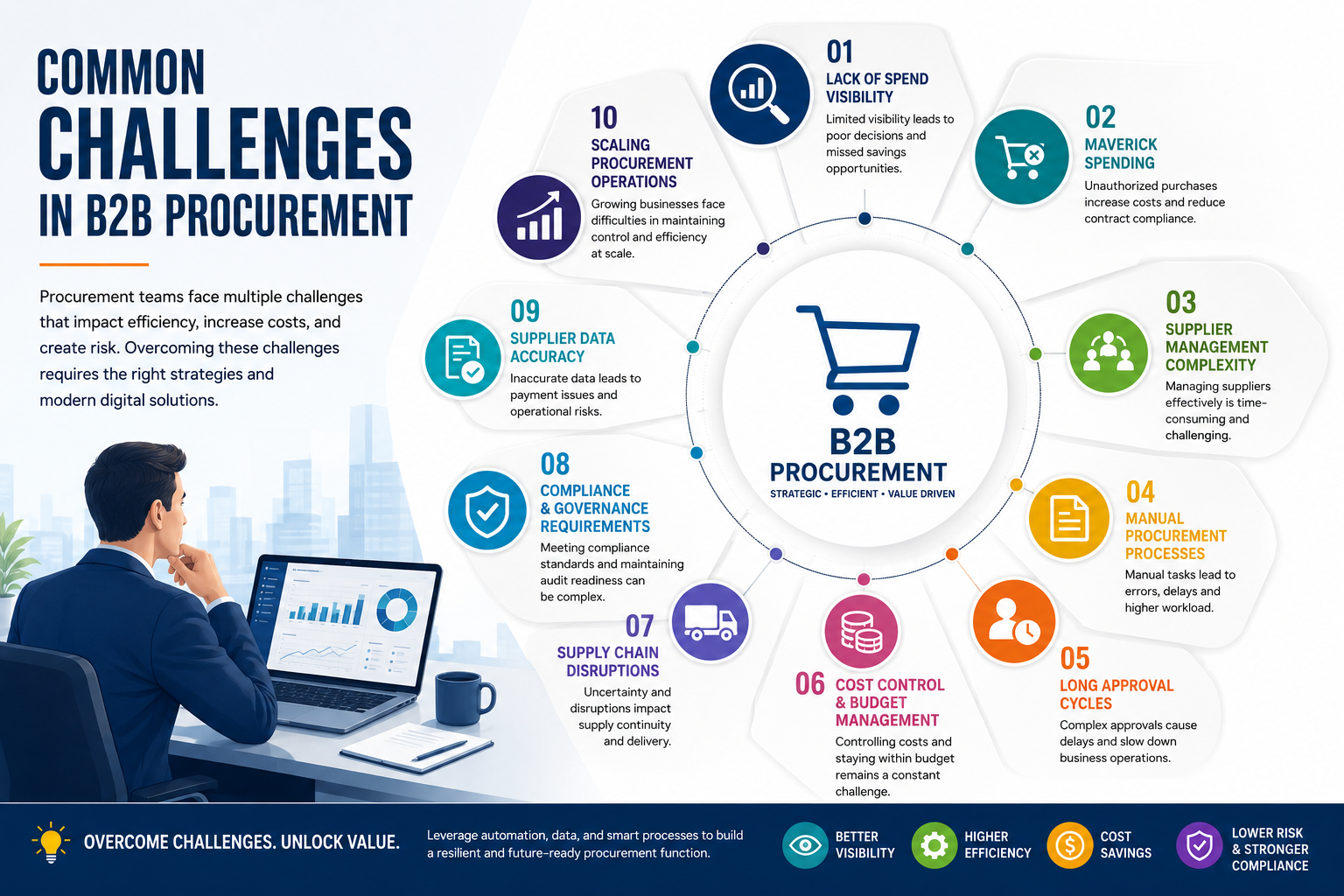
Common Challenges in B2B Procurement
Procurement has evolved far beyond simply purchasing products and services. Modern procurement teams are expected to control costs, manage supplier relationships, ensure compliance, support sustainability initiatives, and contribute to overall business growth.
Despite advancements in digital technology, many organizations continue to struggle with procurement inefficiencies that negatively impact productivity and profitability.
Understanding these challenges is the first step toward building a more resilient, efficient, and strategic procurement function.
- Lack of Spend Visibility
One of the biggest challenges in procurement is understanding exactly where company money is being spent.
Many organizations purchase from multiple suppliers across different departments, often using separate systems or manual processes. As a result, procurement leaders struggle to gain a clear picture of spending patterns.
Without accurate spend visibility, businesses may:
Miss opportunities for cost savings Duplicate purchases Fail to leverage volume discounts Lose negotiating power with suppliers
Solution
Implementing a centralized procurement platform helps consolidate purchasing data into a single source of truth. This allows organizations to analyze spending trends, identify savings opportunities, and make more informed procurement decisions.
⸻
- Maverick Spending
Maverick spending occurs when employees purchase goods or services outside approved procurement channels or supplier agreements.
This is particularly common in large organizations where departments need items quickly and bypass procurement procedures.
The consequences include:
Higher purchasing costs Reduced contract compliance Increased supplier fragmentation Difficulty tracking organizational spending
Solution
Organizations should establish clear procurement policies while providing employees with easy-to-use purchasing tools. Modern procurement systems can automatically direct buyers toward approved products, vendors, and pricing agreements.
⸻
- Supplier Management Complexity
Managing dozens—or even thousands—of suppliers can quickly become overwhelming.
Procurement teams often struggle to maintain accurate supplier information, monitor performance, and ensure vendors meet organizational requirements.
Common supplier management challenges include:
Inconsistent supplier performance Poor communication Delivery delays Limited performance tracking * Compliance risks
Solution
Supplier Relationship Management (SRM) programs help businesses evaluate suppliers based on delivery performance, quality, responsiveness, certifications, and pricing competitiveness.
Organizations that actively monitor supplier performance typically achieve stronger supplier relationships and more reliable supply chains.
⸻
- Manual Procurement Processes
Many procurement departments still rely heavily on emails, spreadsheets, phone calls, and paper-based approvals.
Manual workflows create several issues:
Slow purchasing cycles Increased administrative workload Higher risk of human error Limited audit trails * Approval bottlenecks
In today’s fast-moving business environment, manual procurement processes can significantly impact operational efficiency.
Solution
Digital procurement platforms automate sourcing, approvals, purchase orders, goods receipt processes, and invoice management. Automation reduces administrative tasks and allows procurement teams to focus on strategic initiatives.
⸻
- Long Approval Cycles
Complex approval structures often slow down purchasing decisions.
A simple purchase request may require approvals from multiple stakeholders, causing delays that impact operations and project timelines.
Long approval cycles can result in:
Procurement bottlenecks Missed business opportunities Employee frustration Delayed project delivery
Solution
Organizations should implement workflow automation with predefined approval hierarchies. Automated routing ensures requests reach the appropriate approvers quickly while maintaining governance and compliance.
⸻
- Cost Control and Budget Management
Procurement teams are constantly under pressure to reduce costs while maintaining quality and service levels.
However, achieving cost savings can be difficult when spending data is fragmented or supplier negotiations are inconsistent.
Solution
Effective cost management requires:
Strategic sourcing initiatives Spend analytics Supplier consolidation Contract management * Category-based procurement strategies
Modern procurement technologies provide real-time visibility into budgets and purchasing activity, helping organizations stay within spending limits.
⸻
- Supply Chain Disruptions
Global supply chains have become increasingly vulnerable to disruptions caused by economic uncertainty, geopolitical tensions, natural disasters, and transportation challenges.
Procurement teams must be prepared to manage risks and maintain supply continuity.
Solution
Organizations can improve resilience by:
Diversifying supplier networks Maintaining backup suppliers Conducting supplier risk assessments Monitoring supplier financial health * Building strategic inventory buffers
A proactive risk management approach reduces exposure to unexpected disruptions.
⸻
- Compliance and Governance Requirements
Many industries operate under strict regulatory and compliance requirements.
Procurement teams must ensure purchasing activities comply with:
Internal procurement policies Industry regulations ESG requirements Financial controls * Audit standards
Failure to comply can result in financial penalties and reputational damage.
Solution
Procurement systems with built-in governance controls can enforce policies automatically by restricting purchases, requiring approvals, and maintaining detailed audit trails.
⸻
- Supplier Data and Information Accuracy
Supplier records often become outdated over time.
Incorrect supplier information can lead to:
Payment delays Tax compliance issues Communication breakdowns Increased operational risk
Solution
Organizations should establish supplier onboarding and verification processes that regularly validate supplier credentials, banking information, certifications, and company documentation.
⸻
- Scaling Procurement Operations
As businesses grow, procurement complexity increases.
What works for a small company often becomes unsustainable as transaction volumes rise.
Challenges include:
Managing larger supplier networks Supporting multiple business units Maintaining procurement controls Handling increased purchasing volume
Solution
Scalable procurement platforms enable organizations to standardize processes while maintaining flexibility across departments, locations, and business units.
⸻
The Future of Procurement
Procurement is becoming increasingly strategic. Rather than functioning solely as a purchasing department, modern procurement teams are expected to drive business value through cost optimization, supplier innovation, risk management, and operational efficiency.
Emerging technologies such as artificial intelligence, predictive analytics, automated sourcing, and digital procurement marketplaces are transforming how organizations buy and manage suppliers.
Companies that embrace digital procurement solutions are better positioned to improve visibility, reduce costs, strengthen supplier relationships, and build more resilient supply chains.
⸻
Conclusion
B2B procurement is essential to business success, but it comes with a range of challenges that can impact efficiency, cost control, and operational performance.
From spend visibility and supplier management to compliance and supply chain resilience, procurement leaders must continuously adapt to changing business demands.
Organizations that invest in modern procurement processes, automation, and digital procurement platforms can overcome these challenges while creating a more agile, transparent, and cost-effective procurement function.
As procurement continues to evolve, businesses that modernize their procurement operations today will gain a significant competitive advantage tomorrow.