
How B2B Marketplaces Improve Supplier Access
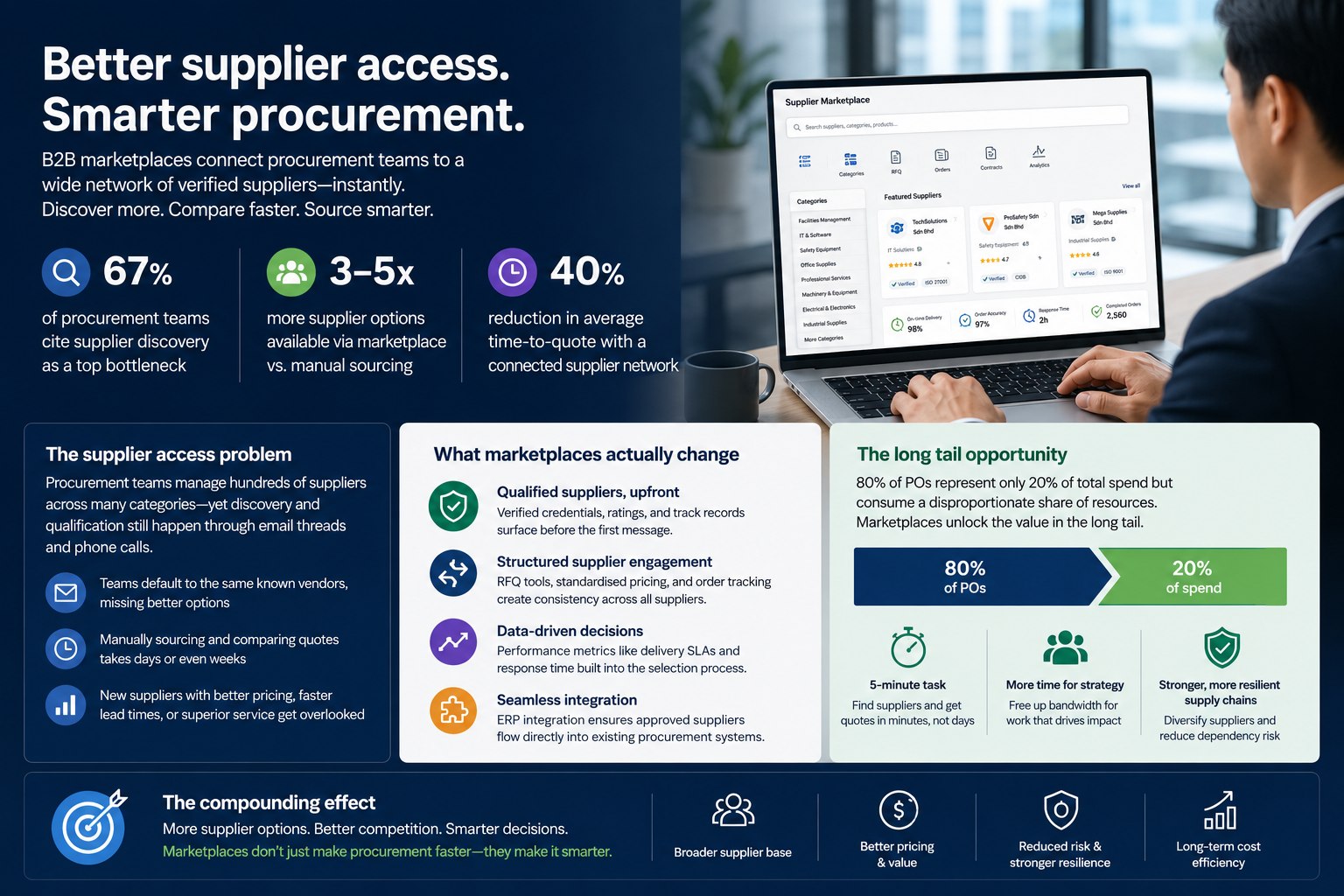
Ask any procurement manager what takes up most of their week, and the answer usually isn't strategy — it's sourcing. Chasing down quotes. Vetting unknown vendors. Manually comparing prices across spreadsheets. The average enterprise deals with hundreds of supplier relationships, yet most of the discovery and qualification process still happens through email threads and phone calls. B2B marketplaces exist to fix exactly that. By aggregating verified suppliers in one accessible platform, they give procurement teams something they've always needed: instant access to a qualified, searchable supplier base — without the weeks of groundwork that typically comes before a single purchase order is raised.
The supplier access problem in enterprise procurement Large organisations — especially GLCs and corporates — operate across dozens of spend categories, from facilities and IT to safety equipment and professional services. For each category, they may need multiple suppliers, often in different regions. Managing that supplier universe manually is unsustainable. The result? Procurement teams default to the same five or ten vendors they've always used. Not because they're the best option — but because they're the known option. New suppliers with better pricing, faster lead times, or superior service simply don't make it through the noise.
67% of procurement teams cite supplier discovery as a top bottleneck 3–5x more supplier options available via marketplace vs. manual sourcing 40% reduction in average time-to-quote with a connected supplier network
What marketplaces actually change A well-built B2B marketplace doesn't just list suppliers — it qualifies them. Verified credentials, ratings, fulfillment track records, and category specialisations are surfaced before a buyer ever sends the first message. That shifts the burden of due diligence from the procurement team to the platform. Beyond discovery, marketplaces introduce structure to supplier engagement. RFQ tools, standardised pricing, and order tracking mean that the process of engaging a new supplier for the first time looks exactly like engaging one you've used for ten years. That consistency is what allows procurement teams to actually broaden their supplier base without creating more operational chaos. What good supplier access looks like:
Verified supplier profiles with category specialisation and compliance documentation Real-time inventory visibility across multiple vendors in one view Standardised RFQ workflows that work for both new and existing suppliers Performance data — delivery SLAs, order accuracy, response time — built into the selection process ERP integration so approved suppliers flow directly into existing procurement systems
The long tail opportunity Enterprise procurement has a well-known 80/20 problem: roughly 80% of purchase orders represent only 20% of total spend — but consume a disproportionate share of procurement resources. This "long tail" of indirect spend is where supplier access gaps are most acute, and where marketplaces deliver the clearest value. When a facilities manager in Kuantan needs three quotations for a one-off equipment purchase, they shouldn't have to spend two days finding suppliers. A marketplace with a deep, verified supplier network makes that a five-minute task — freeing up procurement bandwidth for the strategic work that actually moves the needle.
The compounding effect The real power of improved supplier access isn't any single transaction — it's what happens over time. As procurement teams discover and activate new suppliers, they build a diversified base that reduces dependency on any one vendor. That resilience becomes a strategic asset, particularly when supply chains are disrupted or when a key supplier underperforms. Marketplaces that combine supplier breadth with structured workflows don't just make procurement faster — they make it smarter. And in a business environment where cost efficiency and supply chain agility are non-negotiable, that's no longer a nice-to-have. It's the baseline.