
How Corporate Buyers Use B2B Marketplaces
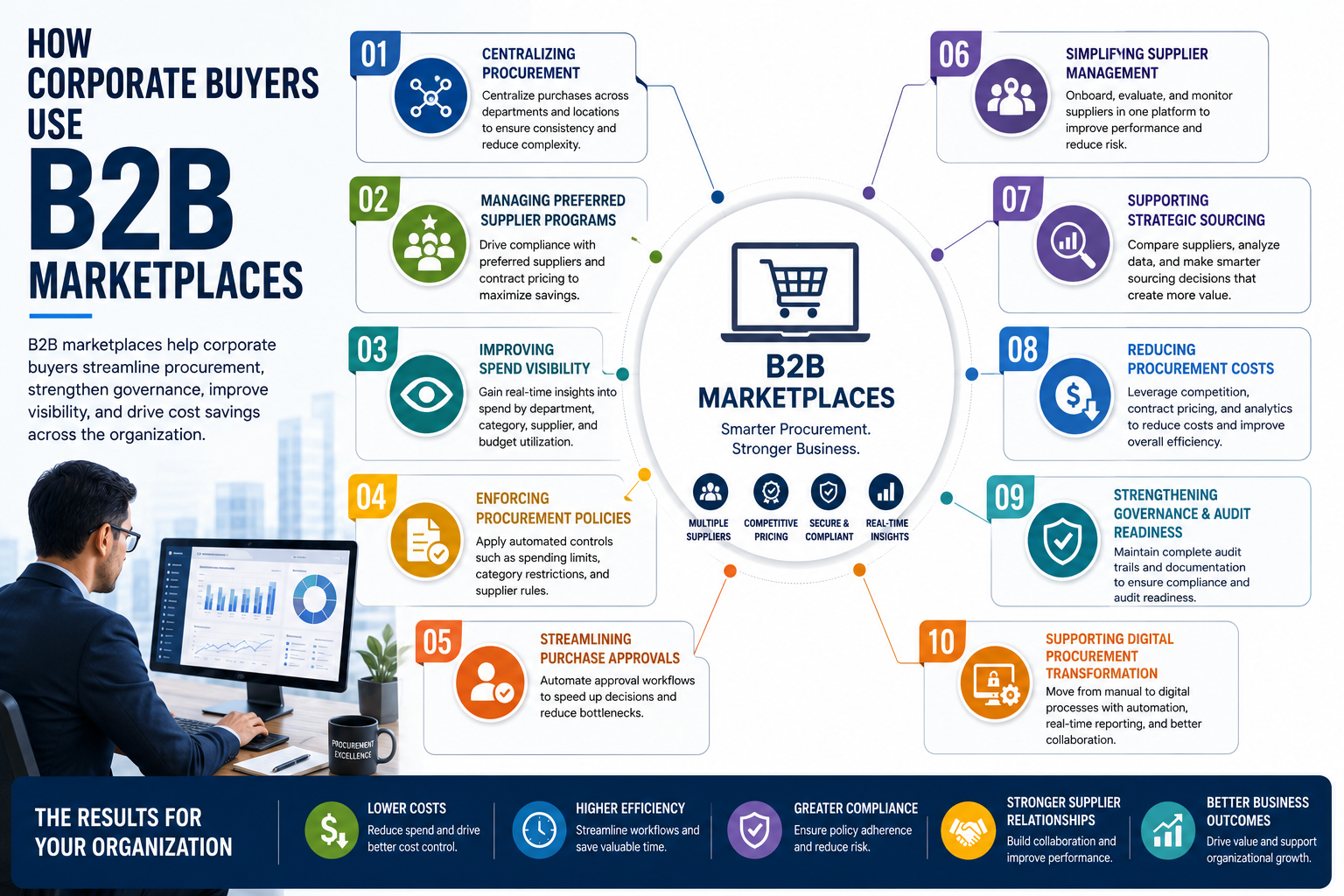
Procurement has become one of the most strategically important functions within modern organizations. Today’s procurement teams are expected to reduce costs, improve operational efficiency, manage supplier risk, and support organizational growth.
Traditional procurement methods often involve fragmented supplier networks, manual processes, and limited visibility into spending. These challenges become increasingly difficult to manage as organizations grow.
To address these challenges, many corporate buyers are adopting B2B marketplaces as part of their procurement strategy.
Far from being simple online stores, modern B2B marketplaces have evolved into comprehensive procurement platforms that help organizations streamline purchasing while maintaining governance and control.
⸻
What Is a B2B Marketplace for Corporate Procurement?
A B2B marketplace is a digital platform that connects organizations with multiple verified suppliers through a centralized purchasing environment.
Instead of managing numerous supplier portals, spreadsheets, emails, and quotations, corporate buyers can access thousands of products and suppliers through a single platform.
This allows procurement teams to:
Source products more efficiently Compare supplier offerings Manage purchasing policies Track spending Improve supplier oversight Automate procurement workflows
For large organizations, this creates significant operational and financial advantages.
⸻
- Centralizing Procurement Activities
One of the primary ways corporate buyers use B2B marketplaces is to centralize purchasing across departments, business units, and locations.
Without a centralized procurement system, organizations often face:
Duplicate purchases Inconsistent pricing Fragmented supplier relationships Limited spend visibility
A B2B marketplace creates a single procurement channel where employees can purchase approved products from approved suppliers.
This improves consistency while reducing procurement complexity.
⸻
- Managing Preferred Supplier Programs
Large organizations often negotiate contracts with preferred suppliers to secure better pricing and service levels.
However, ensuring employees purchase from approved suppliers can be challenging.
Corporate buyers use B2B marketplaces to:
Highlight preferred vendors Restrict unauthorized suppliers Display contract pricing Monitor supplier utilization
This helps organizations maximize negotiated savings while maintaining supplier compliance.
⸻
- Improving Spend Visibility
Procurement leaders need accurate data to make informed decisions.
When purchases occur across multiple channels, gaining visibility into organizational spending becomes difficult.
B2B marketplaces provide real-time insights into:
Department spending Category spending Supplier spending Budget utilization * Purchase trends
With better visibility, organizations can identify cost-saving opportunities and optimize procurement strategies.
⸻
- Enforcing Procurement Policies
Many organizations have procurement policies that govern what employees can buy, who they can buy from, and how much they can spend.
Enforcing these policies manually is often inefficient.
Modern B2B marketplaces allow procurement teams to establish automated controls such as:
Category restrictions Spending limits Budget approvals Supplier restrictions * Purchase authorization workflows
This ensures compliance while reducing administrative overhead.
⸻
- Streamlining Purchase Approvals
Approval bottlenecks are a common challenge in corporate procurement.
Manual approval processes often involve lengthy email chains and delayed decision-making.
B2B marketplaces automate approval workflows by routing purchase requests to the appropriate stakeholders based on predefined rules.
Benefits include:
Faster approvals Improved accountability Reduced paperwork Better audit trails
This enables procurement teams to process requests more efficiently without sacrificing governance.
⸻
- Simplifying Supplier Management
Managing hundreds or thousands of suppliers requires significant effort.
Corporate buyers use B2B marketplaces to consolidate supplier interactions through a single platform.
This allows organizations to:
Onboard suppliers more efficiently Maintain supplier records Track supplier performance Manage certifications and compliance documents * Evaluate supplier reliability
A structured supplier management process helps reduce procurement risk while improving supplier accountability.
⸻
- Supporting Strategic Sourcing
Corporate procurement teams are increasingly focused on strategic sourcing rather than transactional purchasing.
B2B marketplaces support sourcing initiatives by enabling buyers to:
Compare supplier options quickly Evaluate pricing competitiveness Identify alternative suppliers Analyze purchasing patterns
This allows organizations to make data-driven sourcing decisions that improve value and reduce costs.
⸻
- Reducing Procurement Costs
Cost optimization remains a top priority for procurement leaders.
B2B marketplaces help organizations reduce costs through:
Supplier competition Consolidated purchasing Contract pricing Spend analytics * Reduced administrative effort
The combination of direct and indirect savings can generate significant value across the organization.
⸻
- Strengthening Governance and Audit Readiness
Procurement activities must often meet internal governance requirements and external audit standards.
Manual procurement processes can make compliance difficult.
B2B marketplaces create comprehensive audit trails that record:
Purchase requests Approvals Supplier interactions Order history * Invoice documentation
This improves transparency and simplifies audit preparation.
⸻
- Supporting Digital Procurement Transformation
Many organizations are actively pursuing digital transformation initiatives.
Procurement is a key area where technology can deliver immediate improvements.
B2B marketplaces help organizations transition from manual procurement processes to digital workflows by providing:
Automated sourcing Digital approvals Electronic purchase orders Real-time reporting * Supplier collaboration tools
This creates a more agile and efficient procurement function.
⸻
Why Corporate Procurement Is Evolving
Corporate buyers are under increasing pressure to do more with fewer resources.
Procurement teams are expected to:
Reduce operational costs Increase efficiency Manage supplier risk Improve compliance * Support business growth
Traditional procurement systems often struggle to meet these demands.
B2B marketplaces provide a scalable solution that combines supplier access, procurement controls, workflow automation, and spend visibility within a single platform.
As a result, more organizations are incorporating marketplaces into their procurement technology stack.
⸻
Conclusion
Corporate buyers use B2B marketplaces to simplify procurement, improve governance, enhance supplier management, and gain greater visibility into organizational spending.
By centralizing purchasing activities, automating workflows, and providing access to a broad supplier network, B2B marketplaces help procurement teams operate more strategically and efficiently.
As procurement continues to evolve, organizations that embrace digital procurement platforms will be better positioned to reduce costs, strengthen compliance, improve supplier performance, and drive long-term business value.
For modern corporate procurement teams, B2B marketplaces are no longer simply a purchasing channel—they are becoming a critical component of procurement transformation.