
Procurement Challenges in Malaysia
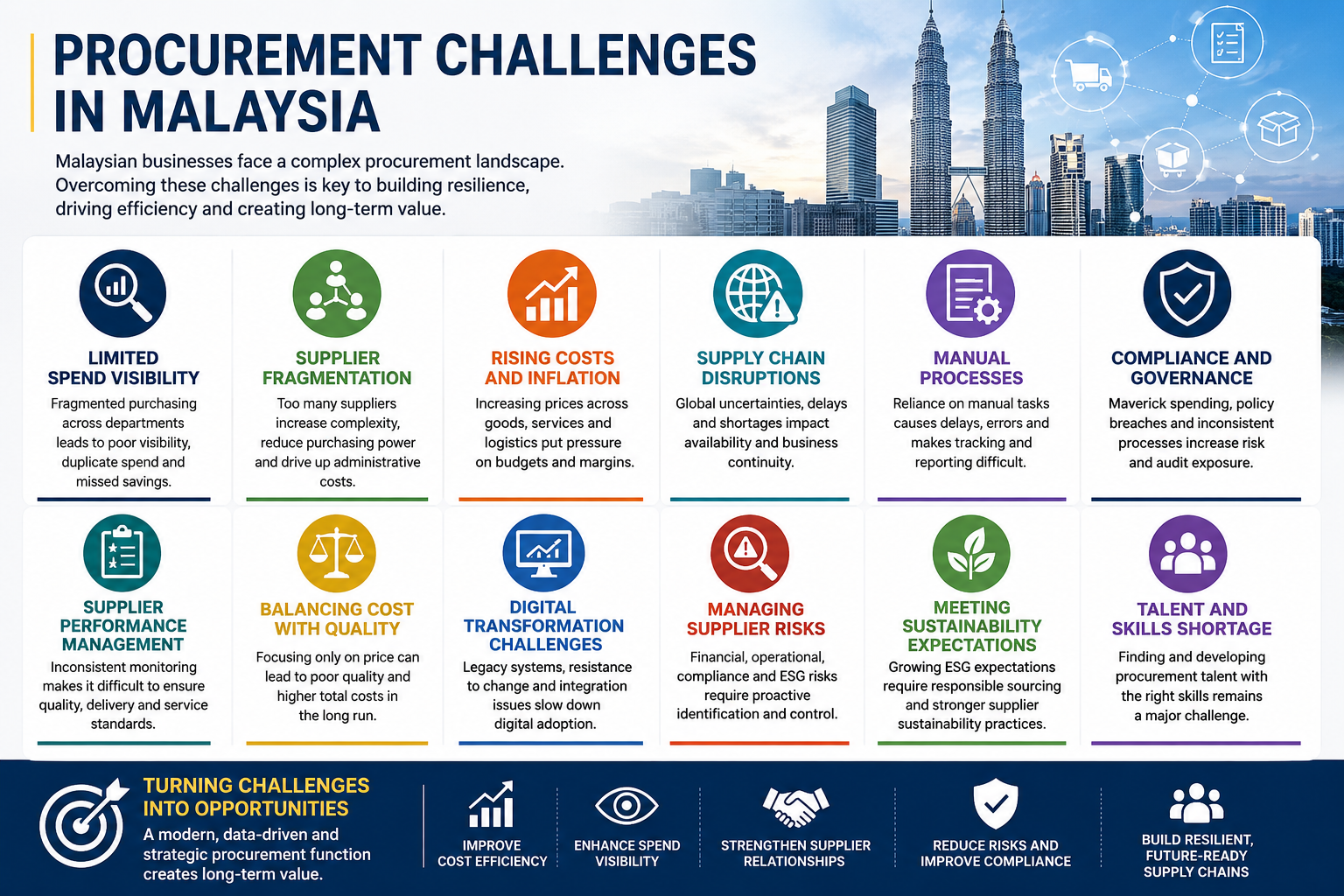
Procurement has become one of the most important business functions in Malaysia. It is no longer simply about purchasing goods at the lowest possible price. Today’s procurement teams are expected to manage supplier relationships, reduce costs, ensure compliance, improve sustainability, and support business growth—all while navigating an increasingly uncertain economic environment.
Whether organisations operate in manufacturing, construction, retail, healthcare, government, or financial services, procurement leaders face a common set of challenges that can significantly impact operational efficiency and profitability.
Below are some of the most pressing procurement challenges facing Malaysian organisations today.
* Limited Spend Visibility
One of the biggest obstacles is the lack of visibility into company-wide spending. In many organisations, purchases happen across multiple departments using different suppliers and processes. Without a centralised procurement system, finance and procurement teams struggle to answer basic questions such as:
Who is buying what? Which suppliers receive the highest spend? Are negotiated contracts being utilised? Where are unnecessary purchases occurring?
Limited visibility often results in duplicate purchases, missed savings opportunities, and poor budgeting decisions.
* Supplier Fragmentation
Many organisations unknowingly work with hundreds—or even thousands—of suppliers providing similar products and services.
This fragmentation increases administrative work, invoice processing, supplier onboarding, contract management, and payment complexity. It also weakens purchasing power because spending is spread across too many vendors instead of being consolidated with preferred suppliers.
Supplier rationalisation remains one of the quickest ways for businesses to improve procurement efficiency.
* Rising Costs and Inflation
Global inflation continues to affect procurement budgets in Malaysia.
Businesses have experienced increasing prices across:
Office supplies Industrial materials Logistics Packaging Technology equipment Food and beverage supplies * Raw materials
Procurement teams are under constant pressure to negotiate better pricing while maintaining product quality and reliable delivery.
Cost reduction strategies have become essential rather than optional.
* Supply Chain Disruptions
Recent global events have highlighted how vulnerable supply chains can be.
Shipping delays, raw material shortages, geopolitical tensions, and transportation bottlenecks have forced procurement teams to rethink sourcing strategies.
Many Malaysian companies are now diversifying suppliers and maintaining contingency plans to reduce dependence on single-source vendors.
Supplier resilience has become just as important as pricing.
* Manual Procurement Processes
Despite rapid digital transformation, many businesses still rely on:
Email approvals Excel spreadsheets Manual purchase orders Paper invoices * Offline supplier communication
These manual processes consume valuable time, increase human error, and make auditing significantly more difficult.
Digital procurement platforms help automate routine tasks while improving speed, transparency, and accountability.
* Compliance and Governance
Procurement policies exist to reduce risk and maintain financial control, but enforcing them across large organisations can be challenging.
Common compliance issues include:
Maverick spending outside approved contracts Purchasing from non-approved suppliers Missing documentation Policy exceptions * Inconsistent approval workflows
Strong procurement governance protects organisations from unnecessary financial and operational risks while improving audit readiness.
* Supplier Performance Management
Selecting the right supplier is only the beginning.
Many organisations struggle to consistently monitor supplier performance across key metrics such as:
On-time delivery Product quality Service responsiveness Pricing competitiveness * Contract compliance
Without measurable supplier performance data, procurement decisions often rely on assumptions rather than evidence.
Regular supplier evaluations help improve service quality and strengthen long-term supplier relationships.
* Balancing Cost with Quality
Reducing procurement costs is important, but selecting the cheapest supplier does not always deliver the best business outcome.
Poor-quality products, unreliable delivery, or inconsistent service can create higher operational costs over time.
Successful procurement teams evaluate suppliers based on overall value, considering quality, reliability, risk, innovation, and long-term partnership potential—not just price.
* Digital Transformation Challenges
Many Malaysian businesses recognise the need to digitise procurement but face challenges during implementation.
Common barriers include:
Legacy systems Resistance to change Budget limitations Integration with ERP systems User adoption Data migration
Successful digital transformation requires more than technology—it requires process redesign, executive support, and continuous user training.
* Managing Supplier Risks
Supplier risk extends beyond delivery delays.
Procurement teams must also consider:
Financial stability Business continuity Regulatory compliance Cybersecurity ESG commitments Ethical sourcing * Operational capacity
Proactively identifying and managing supplier risks helps organisations minimise disruptions before they become costly problems.
* Meeting Sustainability Expectations
Environmental, Social and Governance (ESG) initiatives are becoming increasingly important across Malaysia.
Many organisations are now expected to source responsibly while reducing environmental impact.
Procurement teams are evaluating suppliers based on sustainability credentials, ethical business practices, and responsible sourcing policies alongside traditional commercial considerations.
Sustainable procurement is increasingly becoming a competitive advantage rather than simply a compliance requirement.
* Talent and Skills Shortage
Modern procurement professionals require a diverse skill set that extends beyond purchasing.
Today’s teams must understand:
Data analytics Contract negotiation Risk management Category management Supplier relationship management Digital procurement tools * Strategic sourcing
Finding and developing procurement talent with these capabilities remains a challenge for many organisations.
Turning Challenges into Opportunities
While procurement challenges continue to evolve, they also present opportunities for organisations willing to modernise their procurement function.
Businesses that invest in digital procurement platforms, strengthen supplier relationships, improve spend visibility, automate workflows, and adopt data-driven decision-making are better positioned to reduce costs, improve operational efficiency, and build more resilient supply chains.
In an increasingly competitive Malaysian business landscape, procurement is no longer just a support function. It is a strategic capability that enables sustainable growth, strengthens governance, and creates long-term business value.