
Procurement System Integration for Construction Companies in Malaysia: A Practical Industry Guide
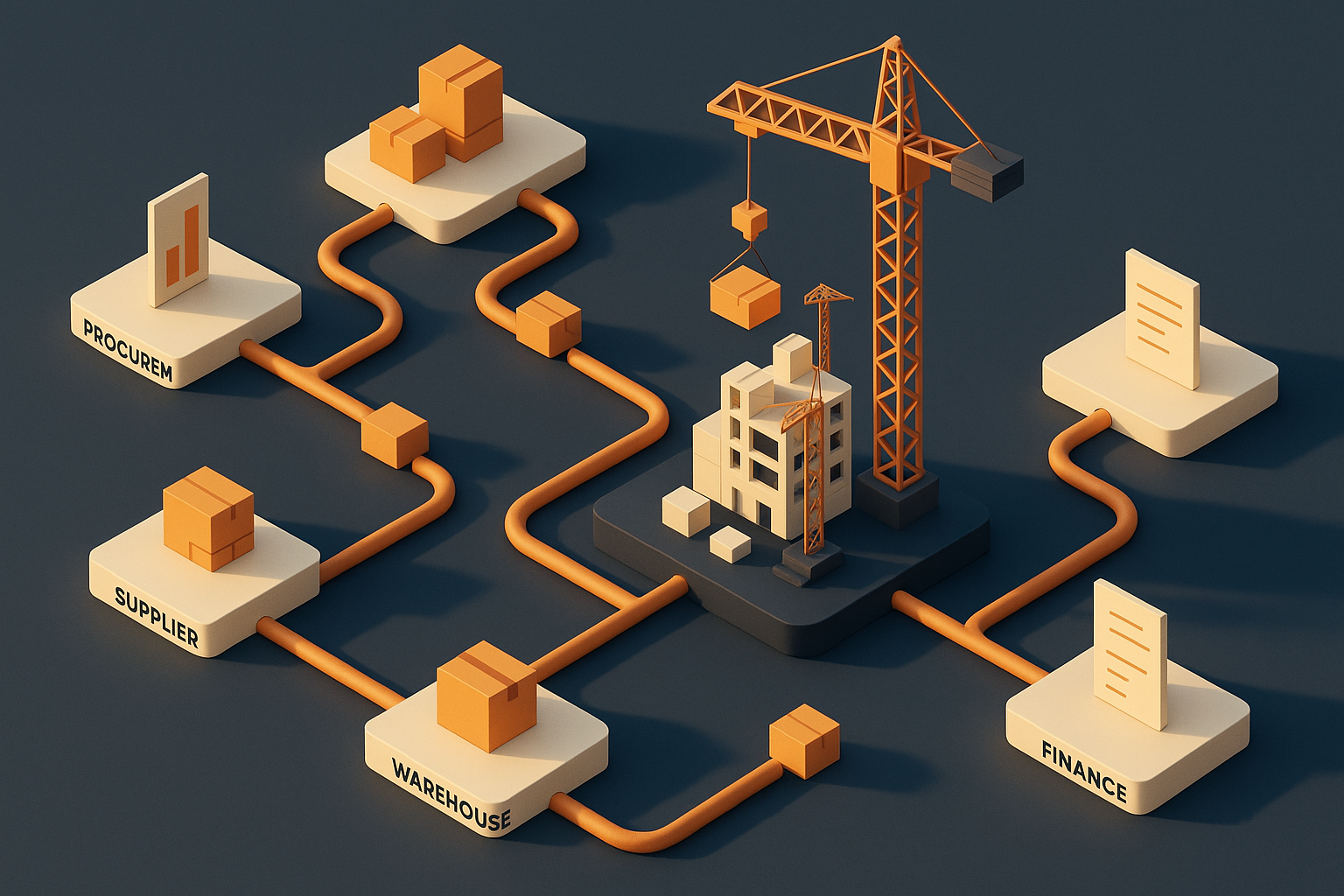
Construction procurement becomes much harder when project teams, finance, site operations and suppliers all work from different systems. For Malaysian construction companies, procurement system integration is not just an IT upgrade—it is a practical way to reduce rekeying, improve approval control, speed up purchasing and create cleaner records for project cost tracking.
Quick answer
Procurement system integration for construction companies in Malaysia means connecting your purchasing workflow with the systems your business already uses, such as ERP, accounting, inventory, project costing, approval and invoicing tools. The goal is to let data move reliably between systems so teams do not keep duplicating work in emails, spreadsheets and manual entries. For most construction companies, the priority is usually to integrate vendor, item, PO, goods receipt, invoice and cost-centre or project-code data first.
Why procurement integration matters more in construction
Construction companies do not buy in one centralised environment alone. They buy across head office, project sites, branches, subcontractor-driven workflows and urgent operational situations. That creates unique procurement pressure points:
- site teams need materials fast
- head office needs approval control
- finance needs accurate coding and documentation
- project managers need visibility into committed and actual spend
- management needs better control over non-contract and ad hoc purchases
- suppliers need clearer orders, delivery points and payment matching
Without integration, many companies end up with a familiar pattern:
- requisitions are raised by email or messaging apps
- buyers manually create POs in another system
- site teams confirm delivery separately
- invoices arrive through email or hard copy
- finance rechecks prices, quantities and project codes by hand
- month-end cost reconciliation becomes slow and error-prone
In construction, these gaps are not small admin inconveniences. They can affect:
- project timelines
- budget tracking
- supplier relationships
- internal control and audit readiness
- the accuracy of management reporting
What procurement system integration actually means
Procurement system integration does not necessarily mean replacing every existing system. In practice, it usually means making key systems work together.
Common systems construction companies need to connect
Depending on company size and structure, the procurement workflow may need to connect with:
- ERP systems
- accounting software
- project costing tools
- inventory or store management systems
- document management systems
- approval workflow tools
- supplier catalogues or B2B purchasing platforms
- AP invoice processing tools
- e-invoicing workflows where applicable
Typical data flows in an integrated procurement setup
A well-designed integration often moves data like this:
- A requester raises a purchase request using a project code, cost centre or site reference.
- The request follows the correct approval matrix.
- Once approved, a PO is generated or synced into the core finance or ERP system.
- Supplier fulfilment and delivery details are captured.
- Goods receipt or service confirmation is recorded.
- The invoice is matched against PO and receipt records.
- Final posting flows into finance and project cost reporting.
That sounds simple, but each step matters because construction procurement often involves split deliveries, substitutions, urgent purchases, partial receipts and multiple delivery locations.
The most important integrations for construction companies
Not every integration should be done at once. The best rollout sequence usually starts with the data and workflows that cause the most friction.
1. Requisition-to-approval integration
This is often the first major win.
When requisitions are disconnected from budget owners and approvers, companies face:
- uncontrolled spot buying
- delayed approvals
- weak audit trails
- confusion over who authorised what
Integration here should ensure:
- requesters choose the correct project or cost code
- approval routing follows company policy
- approved requests cannot be altered without control
- approved data passes cleanly into PO creation
2. Purchase order integration with ERP or accounting
If buyers create POs in one place and finance recreates them elsewhere, duplication becomes unavoidable.
The integration should ideally synchronise:
- supplier records
- item or service descriptions
- quantities and unit prices
- delivery locations
- tax treatment where relevant
- project codes, cost centres or work breakdown references
- PO status
For Malaysian companies, this also helps ensure cleaner documentation for finance records and downstream tax handling, including SST treatment where applicable.
3. Goods receipt and delivery confirmation integration
In construction, receiving is not always neat and centralised. Materials may arrive directly at site, in stages, or be acknowledged by different site personnel.
This creates risk when delivery confirmation is not integrated:
- finance may receive invoices before the site confirms receipt
- quantities may differ from what was ordered
- project teams may not know what has already arrived
- suppliers may dispute delivery or short shipment handling
An integrated process should capture:
- delivery date
- delivery location
- received quantity
- partial receipt status
- damaged or rejected items
- the person or team acknowledging receipt
4. Invoice matching integration
This is critical for control.
Three-way matching—between PO, goods receipt and invoice—is especially useful in construction because of the volume of items, recurring site orders and frequent discrepancies. Integration reduces the burden on finance teams by making mismatches easier to identify before payment processing.
Common mismatch causes include:
- invoice quantity not matching delivered quantity
- incorrect price
- duplicate invoicing
- wrong project code
- invoice raised against the wrong PO
Where Malaysian e-invoicing processes are relevant to the company's setup, procurement and AP data quality becomes even more important because poor upstream records make downstream compliance harder.
5. Supplier master integration
Supplier data should not live in multiple uncontrolled files.
For construction companies, supplier master integration should keep core records aligned, such as:
- legal entity name
- registration details
- tax details where required
- payment terms
- bank details under controlled processes
- category assignments
- approved or restricted status
This is also useful when companies need clearer vendor onboarding governance, including checks related to internal policy, supporting documents, or specific buyer requirements such as MOF registration for relevant projects or customer mandates.
Integrated vs non-integrated procurement in construction
The difference is usually less about software branding and more about process reliability.
| Area | Non-integrated setup | Integrated setup |
|---|---|---|
| Requisition | Raised by email, chat or spreadsheet | Raised in a controlled workflow with project coding |
| Approval | Manual follow-up and unclear status | Routed automatically by role, value or project |
| PO creation | Re-entered across systems | Synced from approved request to finance or ERP |
| Delivery confirmation | Site updates shared separately | Receipt status captured against PO |
| Invoice handling | Finance checks documents manually | Matching supported by PO and receipt data |
| Project cost visibility | Delayed and fragmented | Cleaner committed and actual spend tracking |
| Audit trail | Scattered across inboxes and files | Centralised record of request-to-payment activity |
The construction-specific challenges to plan for
Construction procurement is different from office or standard retail purchasing. Integration design needs to reflect that.
Multiple sites and delivery points
A head office buyer may place orders for many active projects at once. Your integration needs to carry site-level delivery instructions and project references properly, not just company-level purchase data.
Partial deliveries and urgent replacements
Construction materials and MRO items often arrive in stages. Systems should support partial receipts and not force all-or-nothing receiving logic.
Project-based cost coding
Generic cost-centre coding is often not enough. Many construction businesses need more granular project, package, trade or work-stage references to make procurement data useful later.
Mixed purchasing categories
Construction companies buy more than core materials. They also buy:
- PPE
n- janitorial and site consumables
- tools and maintenance items
- temporary facilities supplies
- office supplies
- IT equipment
- pantry items for project offices
- replacement parts
If indirect and tail spend remain outside the integrated workflow, control gaps will continue even if direct procurement improves.
Supplier capability varies
Some suppliers can support digital PO and invoice workflows smoothly. Others still depend on email, phone confirmation or manual documentation. Your integration strategy should accommodate both without forcing procurement teams into exceptions all day.
What to integrate first: a practical priority framework
Construction companies often ask whether they should start with full ERP integration, supplier catalogues, invoice automation or approval controls. The answer depends on where the pain is today.
Start with these questions
- Where is the most manual rekeying happening?
- Which step causes the most approval delay?
- Where do invoice disputes usually begin?
- Which spend categories have the weakest visibility?
- Which projects suffer most from late or inaccurate purchasing data?
A sensible rollout order for many construction companies
| Priority stage | What to integrate | Why it usually comes first |
|---|---|---|
| Stage 1 | Requisition, approval and PO workflow | Builds control and removes manual request handling |
| Stage 2 | Supplier master and item data | Improves consistency and reduces duplicate records |
| Stage 3 | Goods receipt or service confirmation | Strengthens delivery visibility and matching |
| Stage 4 | Invoice matching and AP handoff | Reduces finance workload and payment disputes |
| Stage 5 | Reporting, analytics and project cost views | Turns transactional data into management insight |
How to prepare before integration begins
Technology alone will not fix broken procurement processes. Before implementation, construction companies should align on operating rules.
Standardise your approval logic
Document:
- approval thresholds
- project-based approvers
- emergency purchase rules
- escalation paths
- change rules after approval
Clean up core master data
Review and rationalise:
- supplier lists
- duplicate vendors
- inactive vendors
- item descriptions
- unit-of-measure inconsistencies
- delivery addresses
- project and cost codes
Define receipt ownership clearly
Someone must be accountable for confirming receipt at site. Without that, even a good integration will stall at the matching stage.
Agree exception handling rules
Decide how the business will handle:
- partial deliveries
- over-deliveries
- substitutions
- price variances
- emergency site buys
- non-PO invoices
Common mistakes construction companies should avoid
Trying to integrate everything at once
A big-bang rollout often creates avoidable disruption. Phased implementation is usually safer and easier to manage.
Designing around old workarounds
If the current process depends on too many manual exceptions, integration should simplify the process—not preserve every legacy habit.
Ignoring site-user adoption
If site supervisors, storekeepers or project administrators cannot easily receive goods or confirm deliveries, the process will fall back to WhatsApp messages and paper notes.
Underestimating data governance
Bad supplier data, inconsistent item naming and weak coding structures can undermine even a technically successful integration.
Focusing only on direct materials
Many leakages happen in indirect and tail spend. Construction companies that digitise only major material buys may still struggle with fragmented low-value, high-volume purchases.
What success looks like after integration
A successful procurement integration does not mean every exception disappears. It means routine purchasing becomes much easier to control and manage.
Signs of progress include:
- fewer duplicate entries across teams
- faster approval turnaround
- clearer PO status visibility
- cleaner goods receipt records
- easier invoice matching
- better project spend reporting
- less reliance on inboxes and spreadsheets for basic procurement administration
For leadership teams, the real value is decision quality. Better integrated procurement data makes it easier to understand commitments, monitor purchasing behaviour and spot control weaknesses earlier.
Choosing the right procurement platform or integration approach
Construction companies in Malaysia generally evaluate three broad approaches.
| Approach | Best fit | Watch-outs |
|---|---|---|
| Manual processes with light tools | Very small teams or low purchasing complexity | Limited control, weak visibility, heavy admin |
| ERP-led procurement workflow | Companies with mature internal ERP discipline | Can be rigid for decentralised site buying or indirect spend |
| Specialised procurement platform integrated with finance or ERP | Companies needing better user adoption, supplier access and workflow control | Requires clear integration scope and process ownership |
When assessing options, ask practical questions:
- Can it handle project and site-level purchasing workflows?
- Can approvals follow your internal delegation rules?
- Can it support PO, receipt and invoice matching cleanly?
- Can it manage indirect and tail spend, not just major contracts?
- Can supplier and item data sync reliably with your finance environment?
- Can finance extract clean records for audit and tax documentation?
For businesses buying a broad range of operational and indirect items, it helps to look for a platform purpose-built for indirect and tail spend. Near the end of evaluation, companies may also consider operational depth from a marketplace or fulfilment perspective. For example, Lapasar is MOF-registered and operates its own warehouses and delivery fleet across Peninsular Malaysia, which may matter for companies trying to standardise purchasing and fulfilment across multiple project locations.
Final takeaway
Procurement system integration for construction companies in Malaysia is really about control, speed and data quality across project-based buying. The right setup connects requisitions, approvals, POs, receipts, invoices and project coding so teams can work faster without losing oversight.
The best starting point is not to chase the biggest transformation plan. It is to identify where manual handoffs create the most delay, mismatch or visibility loss—and integrate those workflows first. From there, construction companies can build a procurement environment that supports both site realities and finance discipline.