
Procurement Workflow Automation
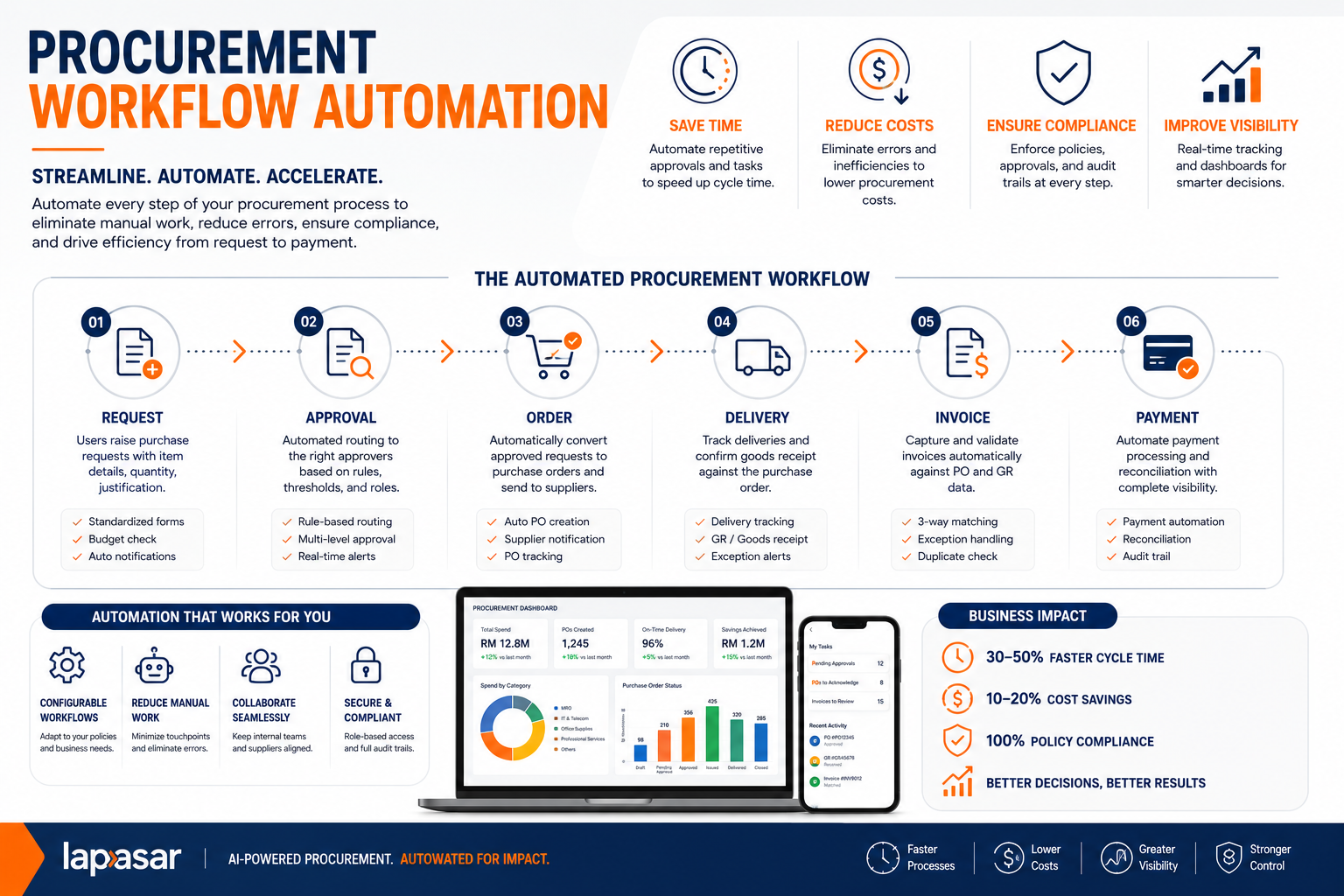
"Procurement automation" is the destination. The workflow is the road — and most enterprises never draw the map.
Ask a CFO what their procurement process is, and you'll get the policy version: requisition, three quotes, approval per the limits of authority, PO, delivery, invoice, payment. Ask the person who actually raises purchases, and you'll get the real version: WhatsApp the vendor, get a price, forward it to the boss, chase him twice, get a thumbs-up emoji, and sort out the paperwork after the goods arrive.
Workflow automation is the discipline of closing the gap between those two versions — making the official process fast enough that the unofficial one dies naturally. Here's how the workflow breaks down, stage by stage, and what automating each one actually involves.
Stage 1: Requisition — kill the blank form
The manual failure: employees describe what they need in free text — an email, a form, a hallway conversation. Procurement then spends its time translating vague requests ("we need printer ink, the usual one") into actual orders, with all the back-and-forth that implies.
The automated version replaces the blank form with a catalogue. Employees pick items with pre-set specifications and pre-negotiated prices; for anything outside the catalogue, a structured request form captures specification, quantity, needed-by date, and budget code up front. The requisition arrives complete the first time.
Design rule: the requisition experience must be faster than going rogue. If raising a compliant request takes ten minutes and a WhatsApp to a vendor takes two, your workflow has already lost. Consumer-grade simplicity isn't a nice-to-have — it's the compliance mechanism.
Stage 2: Approval routing — encode the limits of authority
This is where most cycle time dies in manual processes. Approvals travel by email, wait in inboxes, and depend on people remembering who needs to sign what.
Automated routing encodes the approval matrix directly: below RM 1,000 in an approved category, auto-approve against budget; RM 1,000–20,000, one manager; above that, escalate by value and category. The system checks the budget, routes to the right approvers in parallel where possible, sends reminders, and escalates automatically when someone sits on a request.
The design decision that matters most here is layers. Automating a five-layer approval chain gives you a faster five-layer chain — still too slow. The enterprises that get the biggest gains use automation as the excuse to flatten the matrix: fewer approvers, clearer thresholds, and auto-approval for low-value, in-catalogue, in-budget purchases. If a purchase is under a defined value, from an approved supplier, at a contracted price, within budget — what exactly is a human approval adding?
Stage 3: Sourcing — structured, not email tennis
For purchases without a contracted supplier, the manual version is email tennis: request quotes from three vendors, receive three PDFs in three formats, build a comparison table by hand, and hope nobody questions how the vendors were chosen.
The automated version issues the RFQ to qualified suppliers simultaneously, collects responses in a standard structure, and generates the comparison automatically — price, delivery terms, and past performance side by side. For governance-heavy organisations, this stage is gold: the three-quote requirement stops being a documentation exercise and becomes something the system physically enforces. Nobody can skip it, and nobody can quietly pre-select the winner.
Stage 4: Purchase order — the moment of commitment
In manual processes, the PO is often issued after the fact — the goods were already ordered by phone, and the paperwork catches up later. That means the enterprise's financial commitment happens outside any control.
Automated workflows make the PO the gate: no PO, no order. The PO generates automatically from the approved requisition, transmits to the supplier in a structured format, and creates the record everything downstream reconciles against. This single discipline — commitment only through the system — is what makes every later control possible.
Stage 5: Receiving — close the loop on delivery
The most neglected stage. Goods arrive, someone signs a delivery order, and the paper goes in a drawer. When the invoice arrives weeks later, nobody can confirm what was actually received.
Automated receiving means the person who receives goods confirms quantity and condition against the PO in the system — a two-minute task on a phone. That confirmation does two jobs: it feeds three-way matching (next stage), and it builds the supplier performance record. OTIF — on time, in full — stops being anecdote and becomes data. When contract renewal comes around, you negotiate with a delivery scorecard instead of a vague impression.
Stage 6: Invoice matching and payment — where fraud goes to die
Manual invoice processing is slow, error-prone, and the single biggest fraud surface in procurement: duplicate invoices, inflated quantities, invoices for goods never delivered.
Automated three-way matching compares invoice, PO, and receiving record line by line. Perfect matches flow straight to payment scheduling; mismatches route to a human with the discrepancy highlighted. Staff stop checking the 95% of invoices that are fine and focus entirely on the 5% that aren't. Suppliers get paid faster and more predictably — which, over time, converts into priority treatment and better pricing.
The exception rule: design for the 20%
Every workflow eventually meets a purchase that doesn't fit — an emergency repair at 11pm, a one-off specialist service, a category with no approved supplier. Bad automation pretends exceptions don't exist, and users respond by going around the system, which corrodes everything.
Good workflow design gives exceptions a legitimate fast lane: an emergency purchase path with post-facto approval and a mandatory justification, logged and reported. The goal is not zero exceptions — it's zero invisible exceptions.
What the workflow can't do
A workflow moves information; it doesn't move goods. The most elegant approval chain in Malaysia still ends at a supplier who either delivers on time and in full, or doesn't. Enterprises that automate the workflow but leave supply fragmented across hundreds of unvetted vendors discover they've built a very fast pipe to an unreliable tap. Workflow automation delivers its full return when it sits on top of a dependable supply layer — verified suppliers, contracted pricing, and accountable fulfilment.
Sequence it, don't boil the ocean
The proven implementation order: start with requisition-to-PO for operational and long-tail spend, where volume is high, values are low, and approval logic is simple. Prove the cycle-time gain in one quarter. Then extend to receiving and three-way matching, which delivers the compliance and fraud-control story. Sourcing automation comes last — it touches the most stakeholders and benefits most from the data the earlier stages generate.
Six stages, one principle throughout: make the compliant path the fastest path. Get that right, and policy stops being something you enforce. It becomes something that simply happens.