
The Future of B2B Commerce in Malaysia
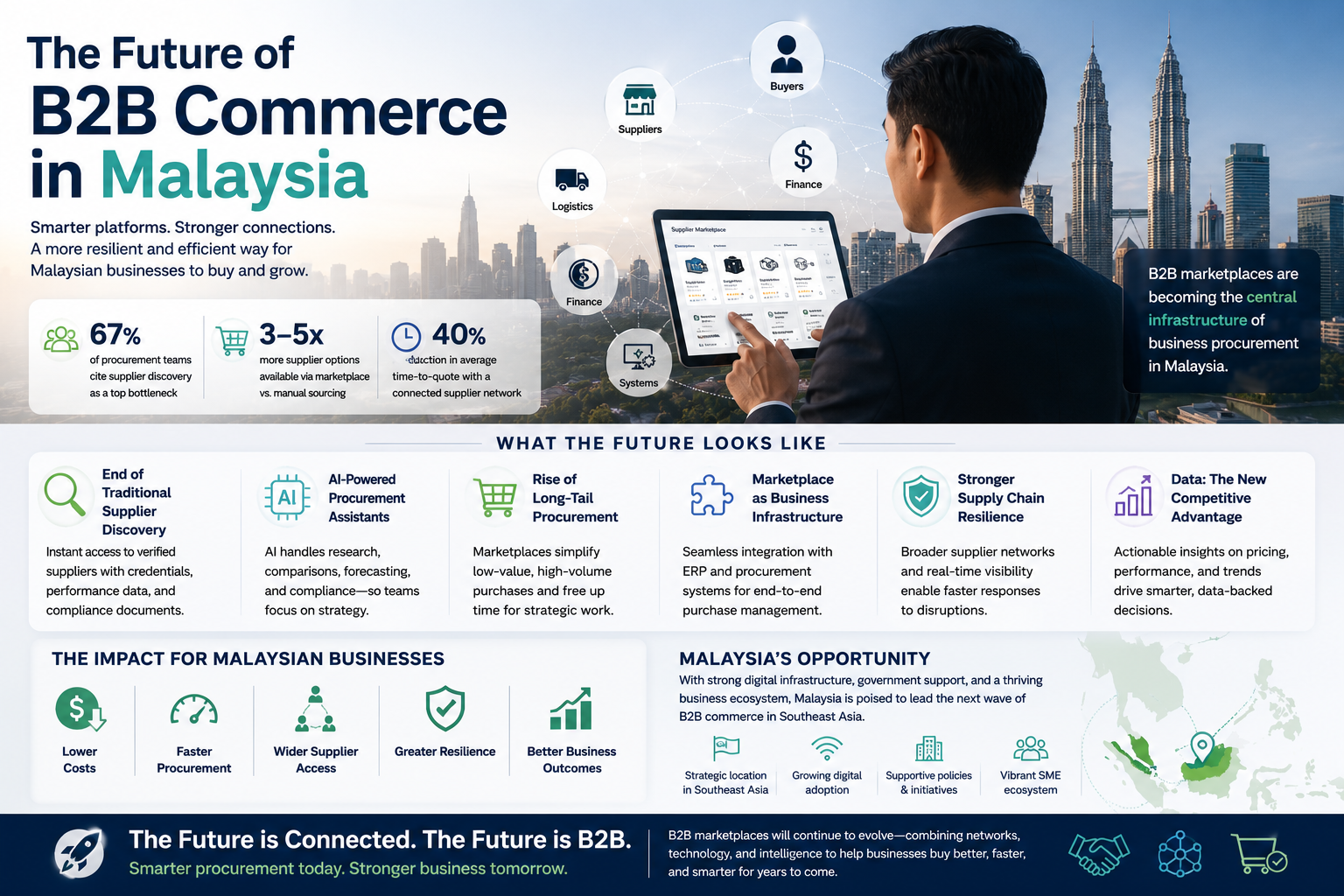
For decades, business purchasing in Malaysia remained largely unchanged. Procurement teams relied on phone calls, emails, spreadsheets, and long-standing supplier relationships to source products and services. While consumer commerce underwent a dramatic digital transformation through platforms such as Shopee and Lazada, much of the B2B world continued operating through manual processes.
That is beginning to change.
Today, rising procurement complexity, supply chain disruptions, labour shortages, and increasing pressure on margins are forcing organisations to rethink how they buy. Across government-linked companies (GLCs), multinational corporations, SMEs, and public sector agencies, digital procurement is rapidly moving from a competitive advantage to a business necessity.
The next decade will see Malaysia’s B2B commerce ecosystem transform from fragmented supplier networks into connected digital marketplaces powered by automation, data, and artificial intelligence.
The End of Traditional Supplier Discovery
One of the largest inefficiencies in procurement remains supplier discovery.
When organisations need a new supplier, the process often begins with internet searches, referrals, emails, and requests for quotations. Procurement teams may spend days or even weeks identifying qualified suppliers before a purchasing decision can be made.
This model is becoming increasingly unsustainable.
Future B2B marketplaces will serve as centralised supplier ecosystems where buyers can instantly discover, compare, and engage verified suppliers across hundreds of categories. Rather than searching for vendors manually, procurement professionals will increasingly rely on platforms that provide:
Verified supplier credentials Compliance documentation Historical performance metrics Delivery reliability scores Pricing benchmarks Category expertise
The result is a procurement process that becomes significantly faster while reducing risk and improving supplier diversity.
AI Will Become Every Procurement Team’s Assistant
Artificial intelligence is likely to become the most disruptive force in B2B commerce.
Today’s procurement professionals spend substantial time performing repetitive tasks such as supplier research, quote comparisons, demand forecasting, and contract reviews. These activities consume valuable resources but add limited strategic value.
In the future, AI systems will handle much of this workload automatically.
Instead of manually sourcing suppliers, procurement managers may simply enter requests such as:
“Find three suppliers for industrial safety gloves with delivery within seven days and pricing below our historical average.”
The platform will instantly return qualified suppliers, compare quotations, identify risks, and recommend the optimal choice.
AI will also assist with:
Spend analysis Supplier performance monitoring Inventory forecasting Contract compliance Price benchmarking Procurement policy enforcement
As these capabilities mature, procurement teams will spend less time administering purchases and more time driving business value.
The Rise of Long-Tail Procurement Marketplaces
Most procurement departments face an often-overlooked challenge known as long-tail spend.
While strategic suppliers account for the majority of procurement value, thousands of low-value purchases consume a disproportionate amount of procurement effort. Office supplies, maintenance items, safety equipment, replacement parts, and ad hoc purchases often require the same sourcing process as major purchases despite representing only a fraction of total spend.
This imbalance creates significant inefficiency.
B2B marketplaces are uniquely positioned to solve this problem.
By providing instant access to thousands of suppliers and millions of products, marketplaces reduce sourcing effort for low-value purchases while maintaining governance and compliance controls.
For procurement leaders, this creates a compelling proposition:
Less administrative work. More strategic focus.
As organisations seek greater efficiency, long-tail procurement is expected to become one of the fastest-growing segments within digital commerce.
Procurement Marketplaces Will Become Business Infrastructure
Historically, marketplaces were viewed as optional purchasing channels.
That perception is changing.
Modern B2B marketplaces increasingly integrate directly into enterprise procurement systems such as ERP, finance, inventory management, and sourcing platforms.
In the future, marketplaces will function less like websites and more like procurement infrastructure.
Buyers will be able to:
Search approved suppliers Generate quotations Create purchase orders Track deliveries Manage invoices Monitor supplier performance
—all within a connected digital environment.
The distinction between marketplace, procurement software, and supplier network will gradually disappear.
Supply Chain Resilience Will Drive Adoption
Recent global disruptions highlighted the risks of supplier concentration.
Many organisations discovered they were heavily dependent on a small number of suppliers. When disruptions occurred, procurement teams struggled to identify alternatives quickly.
Future-ready businesses are now prioritising supplier diversification.
B2B marketplaces provide immediate access to broader supplier networks, making it easier to identify alternative sources of supply when disruptions occur.
The ability to switch suppliers quickly, compare options in real time, and maintain business continuity will become a major driver of marketplace adoption across Malaysia.
Data Will Become the New Competitive Advantage
Every transaction generates valuable procurement intelligence.
Future marketplaces will aggregate purchasing data across industries, categories, and suppliers, creating unprecedented visibility into market trends.
Procurement leaders will gain access to insights such as:
Market pricing trends Supplier performance benchmarks Category spend analysis Demand forecasting * Inflation monitoring
This level of transparency has historically been unavailable to most procurement teams.
Organisations that leverage data-driven procurement decisions will achieve significant advantages in cost control, supplier management, and strategic sourcing.
Malaysia’s Opportunity
Malaysia is uniquely positioned to become a regional leader in digital B2B commerce.
The country benefits from:
Strong digital infrastructure Growing procurement digitisation initiatives High SME participation Significant government support for digital transformation * Strategic access to Southeast Asian markets
As procurement modernisation accelerates, B2B marketplaces have the potential to become foundational infrastructure for Malaysian commerce, connecting thousands of buyers and suppliers through a single digital ecosystem.
Looking Ahead
The future of B2B commerce is not simply about moving procurement online.
It is about transforming procurement into a faster, smarter, and more strategic function.
The next generation of B2B marketplaces will combine supplier networks, procurement workflows, logistics, financial services, and artificial intelligence into a unified platform that simplifies how businesses buy and sell.
Organisations that embrace this shift will gain access to broader supplier networks, lower procurement costs, greater supply chain resilience, and better decision-making.
In the years ahead, the question will no longer be whether businesses should use digital procurement marketplaces.
The question will be how they ever operated without them.