
The Role of Data in Modern B2B Marketplaces
For decades, procurement decisions were often driven by relationships, historical supplier preferences, and manual comparisons.
Today, that is changing rapidly.
As organisations embrace digital procurement, data has emerged as one of the most valuable assets within modern B2B marketplaces. While most businesses initially view marketplaces as platforms for sourcing products and suppliers, the real value often lies beneath the surface—in the data generated by every search, purchase, approval, delivery, and supplier interaction.
In the modern procurement landscape, data is no longer just a reporting tool. It has become a strategic advantage.
Why Procurement Data Matters More Than Ever
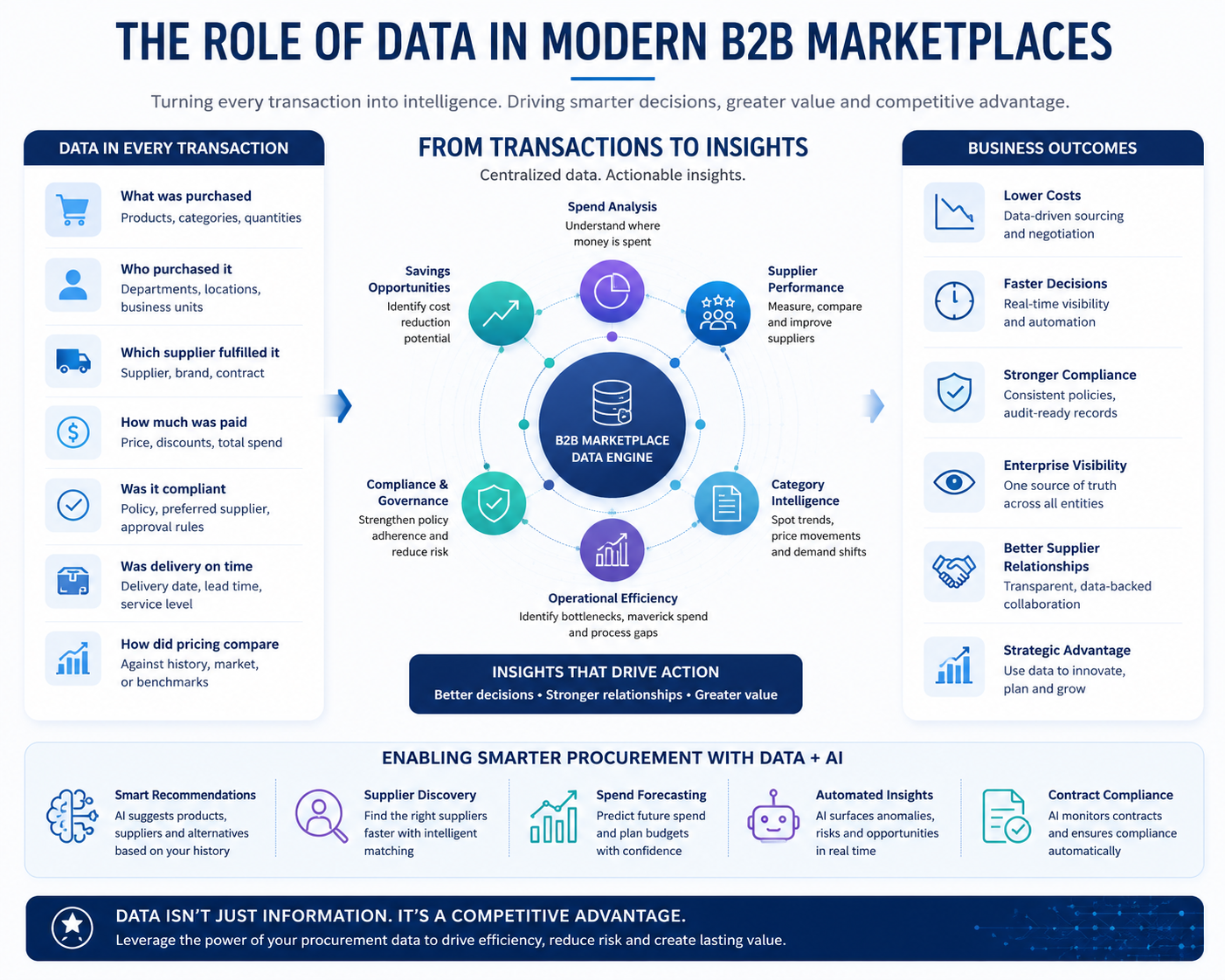
Every procurement transaction generates information.
What was purchased?
Who purchased it?
Which supplier fulfilled it?
How much was paid?
Was the purchase compliant?
Was delivery on time?
How did pricing compare against previous purchases?
Individually, these data points may seem insignificant. Collectively, they create a powerful picture of how an organisation spends money and where opportunities for improvement exist.
The challenge for many organisations is that this data is often fragmented across emails, spreadsheets, ERP systems, procurement software, and supplier records.
Modern B2B marketplaces solve this problem by centralising procurement activity into a single ecosystem, creating a rich and continuously growing source of business intelligence.
From Transactions to Insights
The most advanced B2B marketplaces do far more than facilitate transactions.
They transform procurement activity into actionable insights.
For example, procurement teams can identify:
Frequently purchased items High-spend categories Budget leakage Supplier performance trends Price fluctuations Duplicate purchases Maverick spending behaviour Savings opportunities
Instead of relying on assumptions, procurement leaders gain access to real-time data that supports better decision-making.
This shift enables organisations to move from reactive procurement to proactive procurement.
Improving Supplier Performance Through Data
Supplier management has traditionally been a manual and subjective process.
Procurement teams often evaluate suppliers based on anecdotal feedback or isolated incidents.
Data changes that.
Modern marketplaces can track key supplier metrics such as:
Delivery performance Order fulfilment rates Product quality issues Response times Pricing competitiveness Purchase frequency
With these insights, organisations can identify top-performing suppliers, reduce supplier-related risks, and make more informed sourcing decisions.
Supplier relationships become more transparent, measurable, and accountable.
Enhancing Compliance and Governance
One of the biggest challenges in enterprise procurement is maintaining compliance across multiple departments, business units, and locations.
Without visibility, organisations often struggle to enforce procurement policies consistently.
Data-driven marketplaces help solve this problem.
Every purchase, approval, and supplier interaction is recorded and auditable.
Procurement leaders can quickly identify:
Purchases made outside approved channels Non-compliant suppliers Budget overruns Unauthorised spending * Approval bottlenecks
This creates stronger governance while reducing operational risk.
For regulated industries and large enterprises, these capabilities are becoming increasingly important.
Enabling Smarter Procurement with AI
The future of procurement will be driven by the combination of data and artificial intelligence.
AI systems are only as effective as the data they receive.
Modern B2B marketplaces generate enormous volumes of procurement data that can be used to power intelligent recommendations and automation.
Examples include:
Product recommendations based on historical purchasing patterns Automated supplier suggestions Spend forecasting Budget utilisation predictions Contract compliance monitoring Demand planning * Price benchmarking
As data quality improves, AI becomes increasingly capable of helping procurement teams make faster and more accurate decisions.
Creating Enterprise-Wide Visibility
Large organisations often operate across multiple subsidiaries, departments, and locations.
This can create procurement silos where each team manages purchasing independently.
The result is fragmented data and limited visibility.
Modern B2B marketplaces consolidate procurement activity into a single source of truth.
Management teams gain visibility across the entire organisation, allowing them to:
Consolidate spend Identify savings opportunities Standardise purchasing practices Improve supplier negotiations * Reduce operational inefficiencies
This level of transparency is difficult to achieve using traditional procurement methods.
Data Is the New Procurement Advantage
The evolution of B2B marketplaces is no longer just about connecting buyers and suppliers.
The most successful marketplaces are becoming intelligence platforms that help organisations make better decisions.
Products can be copied.
Pricing can be matched.
Suppliers can be replaced.
But the insights generated through years of procurement activity create a competitive advantage that is difficult to replicate.
Organisations that effectively leverage procurement data will be better positioned to reduce costs, improve efficiency, strengthen governance, and accelerate digital transformation.
In the modern procurement era, the question is no longer whether organisations have data.
The question is whether they are using it to its full potential.