
What Is Supplier Discovery? Definition, Process & Tools for Malaysian Enterprises | Lapasar
What Is Supplier Discovery? A Practical Definition for Enterprise Buyers
Supplier discovery is the process of identifying, evaluating, and qualifying suppliers capable of fulfilling a specific business requirement — before any negotiation or purchasing begins. It's the front door of the entire procurement cycle: everything downstream — sourcing, negotiation, contracting, purchasing — depends on who made it through discovery.
It's also, in most organisations, the least systematised part of procurement. Companies that automated their purchase orders years ago still discover suppliers the way they did in 2005: search engines, trade directories, exhibition name cards, and asking around. That gap is worth understanding, because it's where a disproportionate share of procurement cost, risk, and cycle time hides.
Supplier discovery vs. sourcing vs. supplier management
The terms get blurred, so here's the clean separation. Discovery answers: who out there could supply this? Sourcing answers: of those, who should we invite to quote, and on what terms? Supplier management answers: how are the ones we chose performing? Discovery is upstream of everything. Get it wrong — too narrow a pool, unvetted candidates, the same three incumbent vendors every time — and no amount of downstream negotiation skill compensates. You can't negotiate your way to a good price with the wrong shortlist.
The five stages of supplier discovery
In practice, discovery runs through five stages, whether it takes an afternoon or a month.
Requirement definition. Translating the internal need into supplier-searchable terms: specifications, volumes, delivery locations, certifications required, compliance constraints. Vague requirements produce vague supplier pools.
Identification. Building the long list. Traditionally: search engines, industry directories, trade associations, exhibitions, referrals. Increasingly: B2B marketplaces with structured catalogues and AI-assisted matching that turn a specification into a candidate list in minutes.
Screening. Cutting the long list on hard criteria — can they supply this item, at this volume, to this location, legally? In Malaysia this includes SSM registration, SST status, and increasingly LHDN e-Invoicing readiness; for government-linked buyers, Ministry of Finance registration and Bumiputera status certification where procurement policy requires it.
Evaluation. Assessing the survivors on capability and risk: financial standing, track record, quality certifications (ISO 9001 and sector-specific equivalents), capacity, and references. This is where discovery quality shows — a candidate that clears screening but fails under evaluation six months into a contract is discovery's most expensive failure mode.
Qualification. Formal onboarding into the approved vendor list: documentation, banking verification, compliance declarations, and system registration. Qualified suppliers become the pool that sourcing draws from.
Why traditional discovery is breaking down
Three forces are making the manual approach untenable for enterprise buyers.
The long tail got longer. Enterprises don't struggle to discover suppliers for their top spend categories — those relationships are decades old. The pain is in tail spend: thousands of low-value, infrequent requirements across hundreds of categories. Running a five-stage discovery process for a RM3,000 requirement is economically absurd, so buyers default to whoever's nearest — and pay 15–30% over market for the convenience.
Risk moved into discovery. Supply chain disruptions, ESG obligations, and compliance mandates mean an unvetted supplier is no longer just a price risk. A vendor without e-Invoicing capability creates tax compliance friction; one without proper certifications creates audit findings; one financially fragile creates continuity risk. Discovery is now a risk function, not just a search function.
Search engines stopped being the answer. Google returns whoever bought the ad or won the SEO game, not whoever best fits the requirement. Meanwhile, buyers themselves have changed behaviour — procurement teams increasingly ask AI assistants to recommend suppliers, which means discoverability now depends on structured, machine-readable supplier and product data, not just a website.
What modern supplier discovery looks like
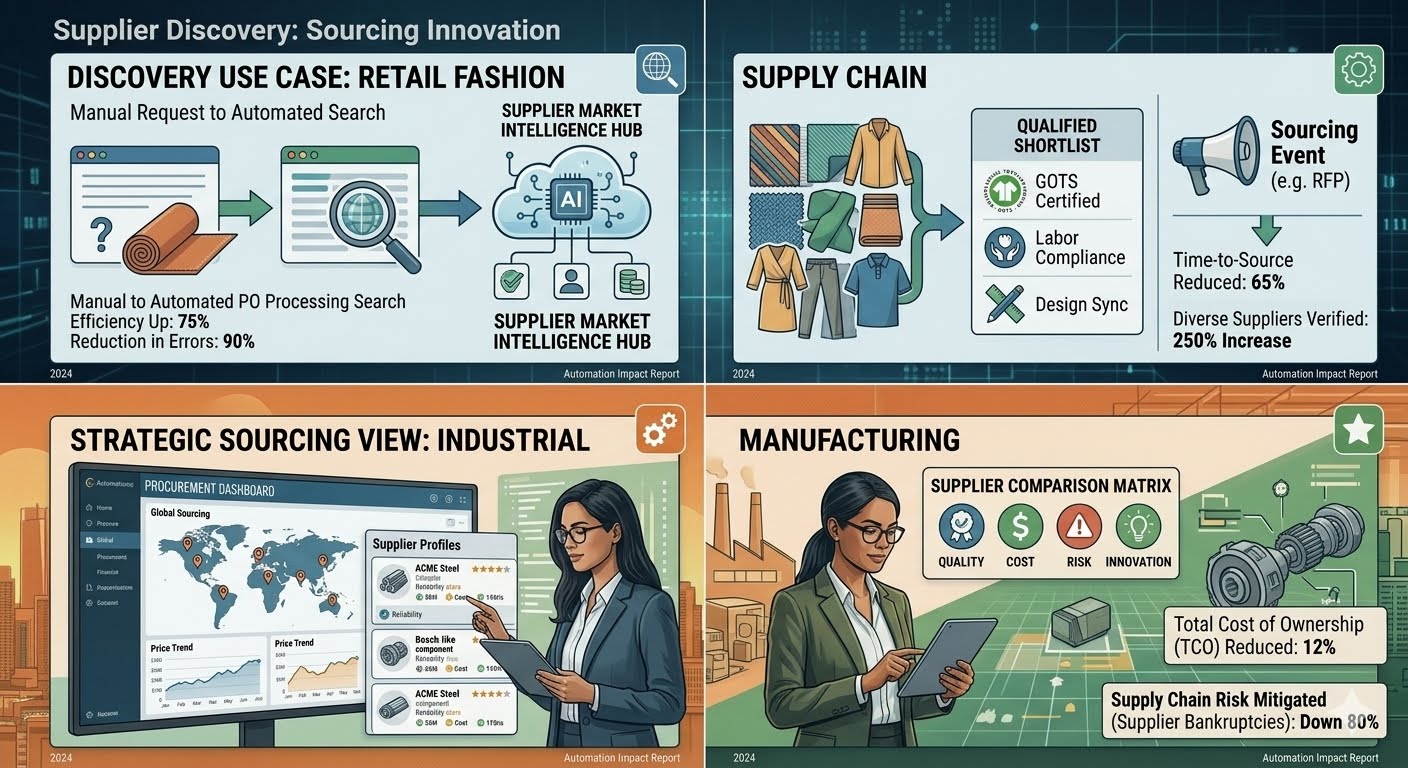
The emerging model inverts the work. Instead of the buyer hunting supplier by supplier, the buyer searches a pre-qualified pool. B2B marketplaces do the heavy lifting once — onboarding, verifying, and structuring supplier and catalogue data — so that discovery becomes a query rather than a project. On a marketplace carrying around two million SKUs from verified Malaysian suppliers, the five-stage process compresses dramatically: identification is a search, screening is already done at the platform level, and evaluation collapses to comparing structured, like-for-like options with transparent pricing.
For the tail spend problem specifically, this changes the economics entirely. Discovery cost per requirement drops toward zero, which means proper process becomes viable even for small purchases — closing the maverick spend gap that manual discovery created in the first place.
The complementary shift is AI-driven matching: describing a requirement in natural language and receiving a ranked, filtered candidate list, with compliance attributes surfaced upfront. Discovery time measured in weeks becomes discovery time measured in minutes — and the audit trail of why a supplier was selected writes itself.
The takeaway
Supplier discovery is the highest-leverage, least-automated stage of procurement. Defined properly, it's a five-stage qualification funnel, not a Google search. And the organisations treating it as infrastructure — pre-qualified pools, structured data, marketplace-scale coverage — are systematically out-executing the ones still doing it by referral and trade directory. The quality of everything procurement does downstream is capped by the quality of who gets discovered upstream. Fix the front door first.