
Why SMEs Are Moving to B2B Marketplaces
Small and medium-sized enterprises (SMEs) form the backbone of most economies. In Malaysia alone, SMEs account for the vast majority of businesses and contribute significantly to employment and economic growth.
However, SMEs often face unique procurement challenges. Unlike large corporations, they typically have limited purchasing power, smaller procurement teams, and fewer resources dedicated to supplier management.
To stay competitive in an increasingly digital economy, many SMEs are shifting away from traditional procurement methods and embracing B2B marketplaces.
These platforms are transforming how businesses source products and services by providing a centralized, digital procurement experience that offers greater efficiency, transparency, and cost savings.
⸻
What Is a B2B Marketplace?
A B2B marketplace is an online platform that connects business buyers with multiple suppliers in one centralized location.
Instead of contacting individual vendors separately, businesses can:
Compare products from multiple suppliers Access competitive pricing Place orders online Track purchases digitally * Manage procurement more efficiently
Examples include procurement marketplaces that offer office supplies, industrial products, IT equipment, cleaning products, MRO items, and other business essentials.
⸻
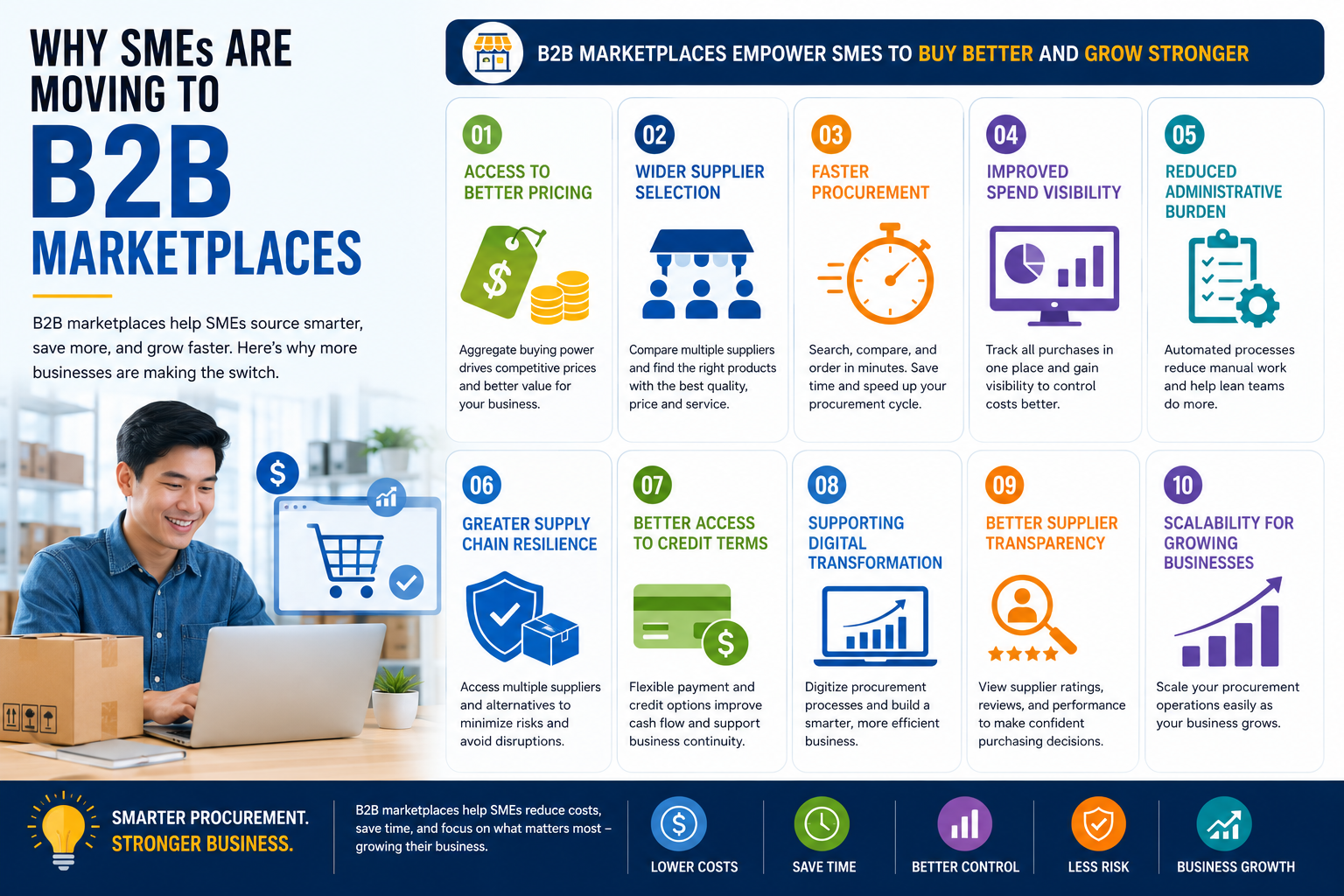
- Access to Better Pricing
One of the biggest reasons SMEs are adopting B2B marketplaces is cost savings.
Traditional procurement often requires businesses to negotiate separately with multiple suppliers. Smaller businesses may not have the purchasing volume needed to secure favorable pricing.
B2B marketplaces aggregate demand across thousands of buyers, allowing suppliers to offer more competitive prices.
Benefits include:
Bulk pricing advantages Transparent price comparisons Reduced procurement costs Better value for money
For SMEs operating with tight budgets, even small savings across frequently purchased items can significantly improve profitability.
⸻
- Wider Supplier Selection
Traditional procurement often relies on a limited network of suppliers.
This can create challenges when:
Products are out of stock Suppliers increase prices Delivery timelines become unreliable Businesses need alternative options quickly
B2B marketplaces provide access to a broader supplier ecosystem.
Instead of depending on a single vendor, SMEs can compare multiple suppliers and select the option that best meets their requirements.
This increased competition also encourages suppliers to maintain competitive pricing and service quality.
⸻
- Faster Procurement Processes
Many SMEs still manage procurement through emails, phone calls, spreadsheets, and manual purchase requests.
These methods consume valuable time and increase administrative workload.
B2B marketplaces simplify the purchasing process by enabling businesses to:
Search products instantly Compare suppliers online Place orders digitally Track deliveries in real time * Maintain digital purchasing records
The result is a faster procurement cycle with fewer manual tasks.
Employees spend less time chasing quotations and approvals and more time focusing on core business activities.
⸻
- Improved Spend Visibility
Many SME owners struggle to understand where procurement budgets are being spent.
Purchases often occur across different departments without centralized oversight.
This can lead to:
Duplicate purchases Unnecessary spending Budget overruns Limited cost control
B2B marketplaces provide centralized purchasing data that helps businesses track spending patterns and identify savings opportunities.
Better visibility leads to better financial decision-making.
⸻
- Reduced Administrative Burden
Supplier onboarding, quotation management, invoice processing, and purchase tracking can be time-consuming.
For SMEs with lean teams, procurement administration often becomes a significant operational burden.
A B2B marketplace reduces complexity by providing:
Consolidated supplier access Digital order management Automated documentation Centralized transaction records
This helps businesses operate more efficiently without increasing headcount.
⸻
- Greater Supply Chain Resilience
Supply chain disruptions have become increasingly common due to economic uncertainty, transportation issues, and global market fluctuations.
SMEs that depend on a small number of suppliers face greater risk when disruptions occur.
B2B marketplaces help reduce this risk by providing access to multiple suppliers for the same product category.
If one supplier experiences shortages or delays, businesses can quickly source alternatives.
This flexibility strengthens procurement resilience and business continuity.
⸻
- Better Access to Credit Terms
Cash flow remains one of the biggest challenges facing SMEs.
Many businesses need access to inventory, supplies, and operational products before receiving payments from customers.
Some modern B2B marketplaces offer:
Business credit facilities Flexible payment terms Buy-now-pay-later solutions for businesses Consolidated invoicing
These financing options help SMEs manage working capital more effectively while maintaining operational continuity.
⸻
- Supporting Digital Transformation
Digital transformation is no longer optional.
Customers, suppliers, and employees increasingly expect digital experiences across all business processes.
B2B marketplaces help SMEs modernize procurement by replacing manual workflows with digital processes.
Benefits include:
Faster approvals Better reporting Improved transparency Reduced paperwork * Enhanced operational efficiency
Digital procurement also creates a foundation for future automation and data-driven decision-making.
⸻
- Better Supplier Transparency
Selecting the wrong supplier can result in delays, quality issues, and increased costs.
B2B marketplaces often provide supplier information that helps buyers make informed decisions.
This may include:
Company profiles Certifications Performance ratings Delivery history * Customer reviews
Greater transparency reduces procurement risk and improves supplier selection.
⸻
- Scalability for Growing Businesses
As SMEs grow, procurement complexity increases.
What works for a small business with ten employees may not work for a company with one hundred employees operating across multiple locations.
B2B marketplaces offer scalable procurement infrastructure without requiring significant investment in procurement systems or additional resources.
Businesses can grow while maintaining procurement efficiency and control.
⸻
The Future of SME Procurement
The future of procurement is increasingly digital, automated, and data-driven.
SMEs that continue relying solely on traditional purchasing methods may struggle to keep pace with competitors that leverage modern procurement technologies.
B2B marketplaces are becoming more than purchasing platforms. They are evolving into comprehensive procurement ecosystems that offer:
AI-powered sourcing Supplier management tools Budget controls Spend analytics Workflow automation Integrated financing solutions
These capabilities help SMEs compete more effectively in an increasingly complex business environment.
⸻
Conclusion
SMEs are moving to B2B marketplaces because they provide a smarter, faster, and more cost-effective way to manage procurement.
From accessing competitive pricing and wider supplier networks to improving spend visibility and supporting digital transformation, B2B marketplaces solve many of the challenges that SMEs face every day.
As procurement continues to evolve, businesses that embrace digital procurement platforms will be better positioned to reduce costs, improve efficiency, strengthen supplier relationships, and support long-term growth.
For SMEs looking to remain competitive in a rapidly changing economy, adopting a B2B marketplace is increasingly becoming a strategic necessity rather than a convenience.