
Improving Inventory Replenishment Planning for Schools and Universities
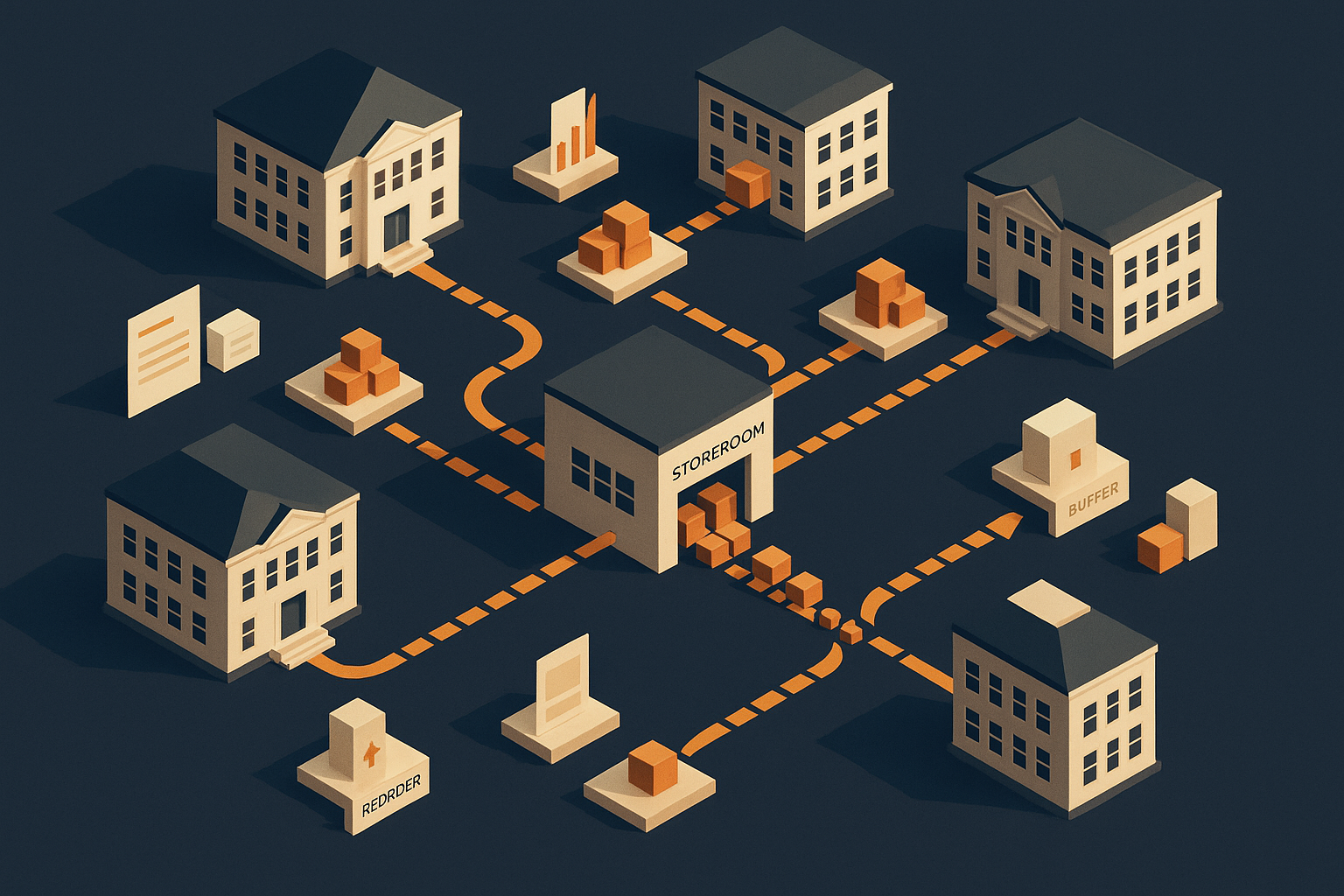
Schools and universities rarely think of themselves as inventory-heavy organisations, yet many campus operations depend on reliable replenishment. From cleaning supplies and stationery to lab consumables, pantry items, maintenance parts and hostel essentials, gaps in stock can disrupt teaching, student services and facility operations very quickly.
Quick answer
Improving inventory replenishment planning for schools and universities starts with separating critical items from routine ones, setting simple reorder rules, and linking demand to the academic calendar. The most effective approach is usually a practical combination of usage history, lead time tracking, minimum stock levels and clearer ownership across procurement, finance, stores and end-user departments.
Why inventory replenishment planning matters in education
In a school or university environment, procurement is rarely buying for just one function. A single institution may need to support:
- Administrative offices
- Classrooms and faculty departments
- Science and technical labs
- Libraries
- Hostels and residential facilities
- Cafeterias or pantry points
- Cleaning and facilities teams
- Maintenance workshops
- Event and student activity units
- Health or nursing rooms
That makes replenishment planning more complicated than simple periodic ordering. Different departments consume items differently, demand changes during intake periods and exam seasons, and some purchases are urgent while others are predictable.
When replenishment is weak, institutions often face the same recurring problems:
- Stockouts of critical consumables
- Overstocking of slow-moving items
- Emergency purchases at higher cost
- Duplicate ordering across departments
- Expired or obsolete supplies sitting in stores
- Budget surprises late in the term or financial year
- Disputes over who approved what and why
Good replenishment planning reduces those problems by making purchasing more predictable and less reactive.
What schools and universities should replenish differently
Not every item should be planned the same way. One of the biggest mistakes in education procurement is treating all inventory as if it has identical urgency, demand stability and supply risk.
Group inventory by operational role
A practical first step is to classify inventory into functional groups such as:
- Critical operational items: tissue, soap, cleaning chemicals, printer toner, exam materials, basic first-aid consumables
- Academic consumables: lab gloves, reagents, art materials, workshop supplies, paper, markers
- Facilities and maintenance items: bulbs, fittings, basic repair parts, safety gear
- Residential and welfare items: hostel cleaning items, pantry supplies, mattress covers, hygiene products
- Seasonal or event-driven items: orientation kits, convocation items, open day materials, club event supplies
- Low-priority routine items: general stationery, meeting refreshments, miscellaneous office supplies
This makes it easier to set different replenishment methods rather than forcing one blanket rule across campus.
Focus first on the items that cause disruption
If a school storeroom or university central store manages hundreds or thousands of SKUs, do not try to optimise everything at once. Start with items that are:
- Frequently used
- Difficult to substitute
- Required for health, safety or compliance
- Necessary for teaching continuity
- Prone to urgent last-minute purchase requests
For many institutions, the highest-value improvement comes from controlling a relatively small group of operationally important items.
A simple replenishment planning model for education institutions
The best replenishment model is not always the most complex one. Many schools and universities can improve quickly with a clear, disciplined process.
Step 1: Build a usable item master
Before setting reorder rules, make sure the item list itself is clean. Common problems include duplicate descriptions, inconsistent units of measure and unclear pack sizes.
Standardise:
- Item name and description
- Unit of measure
- Pack size
- Preferred supplier if applicable
- Department owner or main user
- Category
- Whether the item is critical, routine or seasonal
Without this foundation, usage data becomes unreliable and replenishment decisions become guesswork.
Step 2: Review real consumption, not just purchase history
Purchase history alone can mislead. A large order may reflect delayed buying, budget timing or one-off events rather than normal demand.
Look at:
- Actual issue-out from stores to departments
- Consumption by month or term
- Peak usage periods
- One-off spikes that should be excluded from baseline planning
- Items frequently requested urgently
For schools and universities, link demand to the academic calendar. Consumption often changes around:
- New student intake
- Start of semester
- Examination periods
- Laboratory-heavy teaching blocks
- Hostel move-in periods
- Major campus events
- Year-end closures or stock counts
Step 3: Track supplier lead time realistically
Replenishment planning fails when lead time assumptions are too optimistic. If staff assume an item can arrive quickly but the actual supplier cycle is longer, stockouts become inevitable.
Track lead time from:
- Requisition submission
- Approval completion
- Purchase order release
- Supplier fulfilment
- Delivery to store or department
- Goods receipt and put-away
This is important because the true replenishment cycle includes internal delays, not only supplier delivery time.
Step 4: Set reorder point and minimum stock rules
Once demand patterns and lead times are clearer, define practical triggers for reordering. For most education institutions, a simple reorder point approach is easier to manage than a highly technical forecasting model.
A workable rule can include:
- Minimum stock level: the lowest quantity allowed before action is needed
- Reorder point: the stock position that triggers a purchase request or PO
- Buffer stock: extra quantity held for uncertainty in demand or lead time
- Maximum stock level: an upper limit to avoid over-ordering and storage waste
Critical items should generally have more protective buffer than non-critical ones, especially where campus operations cannot tolerate interruption.
Step 5: Decide which items should be centrally stocked
Not every item belongs in a central storeroom. Some are better ordered directly by end-user departments, especially if they are:
- Specialised
- Infrequently used
- Bulky to store
- Unique to a single faculty or lab
Central stocking works best for common-use, repeat-purchase items with relatively stable demand. Decentralised direct ordering works better for niche items where central inventory would just sit idle.
Comparing replenishment approaches for schools and universities
Different item types call for different replenishment methods.
| Approach | Best for | Strengths | Risks | Education example |
|---|---|---|---|---|
| Fixed schedule ordering | Stable, routine items | Easy to manage and budget | Can over-order or miss demand swings | Monthly restock of office stationery |
| Reorder point / min-max | Frequently used operational items | Responsive to actual consumption | Needs accurate stock records | Cleaning supplies for classrooms and toilets |
| Seasonal build-up | Intake, exams, major events | Matches calendar-based demand | Forecast can be inaccurate | Orientation materials or exam stationery |
| Direct departmental ordering | Specialised or low-frequency items | Reduces central storage burden | Less visibility and more duplication risk | Department-specific lab materials |
| Emergency-only purchasing | Truly exceptional situations | Useful for urgent incidents | Expensive and hard to control if overused | Immediate maintenance item for critical repair |
For most institutions, the strongest model is a hybrid: central replenishment for common operational items, calendar-based planning for seasonal demand, and controlled direct buying for specialist needs.
Common replenishment mistakes in education procurement
Treating the academic year like a flat demand pattern
Demand in education is rarely even across the year. If planning ignores semester starts, intake periods or exam cycles, stock will be available at the wrong time.
Allowing every department to use different item descriptions
When one faculty orders an item under one description and another uses a different name for essentially the same product, spend visibility and replenishment planning suffer.
Using emergency purchases as a normal operating model
Urgent buying should be the exception. If many purchases are marked urgent, that usually signals weak forecasting, poor stock visibility or slow approvals.
Failing to separate critical from non-critical items
A stockout of whiteboard markers is inconvenient. A stockout of essential cleaning supplies, safety consumables or lab basics may disrupt operations more seriously. Planning effort should reflect that difference.
Ignoring expiry, shelf life or storage conditions
Some institutions overbuy to feel safe, especially for consumables. But chemical supplies, certain hygiene products and some pantry items may have shelf-life limits or storage constraints.
How procurement, finance and user departments should work together
Replenishment planning is not just a storekeeper task. It requires cross-functional discipline.
Procurement's role
Procurement should:
- Standardise commonly bought items
- Consolidate demand where appropriate
- Monitor supplier performance and lead times
- Reduce off-contract or duplicate purchases
- Build ordering calendars for predictable categories
Finance's role
Finance should:
- Align budgets with realistic consumption cycles
- Watch for year-end buying distortions
- Support clearer coding of inventory-related spend
- Review emergency purchases as a control signal
For Malaysian institutions, finance teams may also want to ensure documentation supports internal controls, audit needs and tax treatment where relevant, including SST handling when applicable.
Department users' role
End-user departments should:
- Forecast known events earlier
- Avoid last-minute requests for predictable needs
- Use standard items unless there is a justified exception
- Report demand changes quickly
Stores or operations team's role
Stores and operations teams should:
- Maintain accurate on-hand balances
- Record issues and receipts promptly
- Flag slow-moving and obsolete stock
- Escalate low-stock risk before service disruption occurs
Practical KPIs to monitor without overcomplicating the process
Schools and universities do not need a sophisticated dashboard to improve. Start with a short list of operational indicators:
- Number of stockouts for critical items
- Number of emergency purchase requests
- Average replenishment lead time
- Inventory ageing for slow-moving stock
- Order frequency by item category
- Budget variance for routine consumables
- Rate of duplicate or non-standard item requests
These measures help teams identify where process fixes are needed.
How to improve replenishment planning with limited systems
Many institutions still manage inventory using spreadsheets, email approvals and disconnected purchase records. While not ideal, meaningful improvement is still possible.
If your process is mostly manual
Start with:
- A standard item list for common supplies
- A monthly review of high-use categories
- Minimum stock levels for critical items
- A shared replenishment calendar tied to term dates
- A simple log of urgent purchases and their causes
Even these basic controls can reduce avoidable disruptions.
If your institution is moving toward digital procurement
As volume and complexity grow, digital tools become more valuable for:
- Spend visibility across faculties and campuses
- Approval workflow control
- Supplier and catalogue standardisation
- Budget checks before ordering
- Better usage reporting by category and department
For indirect and tail spend categories, a structured procurement platform can help institutions reduce fragmented ordering and improve replenishment discipline. Near the end of a broader digitalisation journey, some organisations also look for one place to manage catalogues, approvals and routine restocking across departments. Lapasar is MOF-registered and purpose-built for indirect and tail spend, which is relevant for many of the supplies educational institutions buy repeatedly.
A realistic implementation plan for schools and universities
Trying to redesign all replenishment rules at once usually creates more confusion. A phased approach works better.
Phase 1: Stabilise critical items
Focus on:
- Cleaning supplies
- Washroom consumables
- Printer and office essentials
- Basic maintenance items
- Frequently used academic consumables
Set clear minimum levels and assign ownership.
Phase 2: Align to the academic calendar
Map annual demand peaks and build planned ordering windows for:
- Intake periods
- Exams
- Events
- Hostel operations
- Faculty-specific teaching cycles
Phase 3: Standardise and consolidate
Reduce duplicate items, harmonise specifications and centralise repeat purchases where it makes operational sense.
Phase 4: Digitise visibility and controls
Introduce better reporting, approval governance and supplier catalogue management so replenishment becomes data-led instead of reactive.
The main takeaway
Improving inventory replenishment planning for schools and universities is less about complex forecasting and more about operational discipline. When institutions classify items properly, tie demand to the academic calendar, track real lead times and set simple reorder rules, they can reduce stockouts, limit waste and support smoother campus operations.
The most effective replenishment plans are practical, cross-functional and easy to maintain. In education, that matters because procurement success is not measured only by lower purchase prices, but by keeping classrooms, labs, hostels and support services running without interruption.